



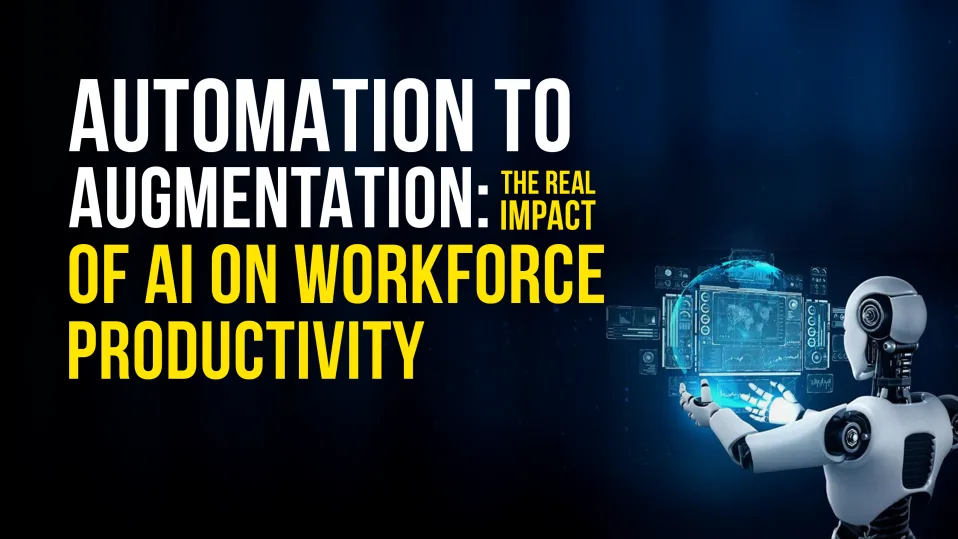
India’s economy is rapidly evolving, and with it, the role of artificial intelligence (AI) is undergoing a profound transformation. Where AI once sparked fears of massive job losses and workforce displacement, it is now increasingly recognised as a powerful force for augmenting human capabilities and boosting productivity. This shift is especially important for India’s vast and diverse workforce, including the crucial micro, small, and medium enterprises (MSMEs) sector, where AI-driven innovation can be a game-changer.
AI’s Impact on Workforce Productivity in India
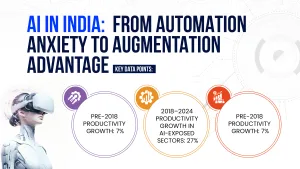
Recent industry reports highlight an impressive productivity surge in AI-exposed sectors in India—from just 7% growth pre-2018 to a remarkable 27% growth between 2018 and 2024. This jump is accompanied by a 56% wage increase for skilled workers, underscoring AI’s potential to not only make businesses more efficient but also improve employee compensation.
The PHD Chamber of Commerce and Industry (PHDCCI) has taken a proactive stance, viewing this transition as critical for MSMEs. To ensure that these businesses and their workforces are equipped for the future, PHDCCI launched its Centre of Excellence in AI and Robotics, focusing on reskilling and capacity-building initiatives. This strategic move is key to helping MSMEs leverage AI for sustained growth amid global digital competition.
AI’s Dual Role: Automation and Augmentation
AI’s effect on workforce productivity operates on two powerful fronts—automation and augmentation—each playing distinct but complementary roles.
Automation: Efficiency through Task Automation
Automation eliminates repetitive, mundane tasks, freeing employees to concentrate on higher-value, strategic work. Globally, 91% of businesses deploy AI to cut down administrative workloads by over 3.5 hours per week per employee. In customer support, generative AI boosts issue resolution rates by 15% per employee per hour, showing how AI scales operational capacity with better quality service.
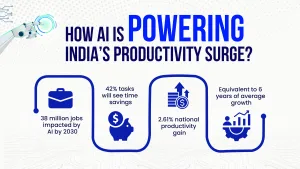
In the Indian context, EY’s forecasts suggest AI will impact 38 million jobs by 2030. While 24% of these roles’ tasks will be fully automated, an additional 42% of tasks will see significant time savings due to AI, contributing to a national productivity gain of 2.61%. This productivity boost is comparable to six years’ worth of average growth, positioning AI as a catalyst for India’s future economic trajectory.
PHDCCI’s November 2025 workshop on AI tools for everyday business raised awareness among over 50 delegates from diverse sectors, focusing on how automation can be practically applied. Particularly in software development and call center industries, AI-driven automation has already delivered productivity surges ranging from 60% to 80%. Such data aligns with PHDCCI’s hands-on training approach, emphasizing the practical application of AI, IoT (Internet of Things), and RPA (Robotic Process Automation) technologies.
Augmentation: Enhancing Human Potential
Beyond automation, AI augments human intelligence, acting as a collaborative partner to improve decision-making and creativity. Accenture’s research shows that companies integrating generative AI into their workflows outperform peers with 2.5 times higher revenue growth and 2.4 times better productivity. Additionally, 74% of these companies meet or exceed their AI-related business expectations.
MIT studies shed light on augmentation benefits by focusing on “centaur” models—where AI handles repetitive or data-heavy tasks while humans retain control over judgment and creativity. Skilled workers leveraging AI saw a 40% boost in performance. In India, EY estimates generative AI-driven augmentation could lift productivity by 5.44% by 2030, as tasks become more collaborative and less routine.
PwC also highlights a 66% faster rate of skill evolution in AI-driven sectors, reflecting the urgent need for workforce adaptation. PHDCCI’s Centre of Excellence fosters this synergy between industry and academia by promoting AI use that enhances rather than replaces jobs, ensuring Indian workers remain indispensable assets.
India-Specific Trends and Challenges in AI Adoption
India faces a dual challenge with AI adoption: the risk of job displacement and the significant opportunity for new AI-driven roles.
The International Labour Organisation (ILO) estimates that 70% of jobs could be at risk of automation, with forecasts of up to 20-25 million workers displaced by 2030—particularly in IT, retail, and financial sectors. However, Bain & Company offers a positive counterpoint by projecting 2.3 million AI-related job openings by 2027, creating a need to reskill approximately 1 million workers annually to meet a 21% year-over-year rise in skill demand.
PHDCCI addresses these challenges head-on through collaborative initiatives with the All India Council for Robotics & Automation (AICRA), focusing on current AI augmentation waves like automating form processing and data analysis, and anticipating more autonomous AI applications in the near future.
Government support through the IndiaAI Mission, with a sizable budget of INR 10,000 crore, also backs infrastructure development such as datasets, GPUs, and ethical AI frameworks—elements that complement PHDCCI’s efforts. For example, PHDCCI’s recent conference on AI in fraud detection highlighted the Reserve Bank of India’s alarming ₹36,000 crore rise in digital fraud, showcasing AI’s role in safeguarding digital economies.
PHDCCI’s Strategic Roadmap for MSMEs
MSMEs form the backbone of India’s economy, yet they face unique challenges in adopting AI technologies. PHDCCI urges MSMEs to focus on augmentation rather than fearing automation. Industry leaders estimate that 40% of the MSME workforce will require upskilling or reskilling to effectively integrate AI tools.
To empower these enterprises, PHDCCI organizes workshops and training programs offering practical skills in AI implementation, research, and entrepreneurship. These initiatives help bridge the gap from automation-focused task shifts to deeper AI-enabled augmentation, enabling MSMEs to innovate and compete in a digital economy.
Research-backed case studies reinforce this approach:
- Coders assisted by AI tools report productivity increases of 126%
- Professionals using AI-enhanced document processing experience 59% faster completion times
To ensure sustainable growth, PHDCCI also advocates for ethical AI policies aligned with India’s governance frameworks, focused on mitigating bias and ensuring privacy protection. By fostering responsible AI adoption, MSMEs can build trust with customers and regulators alike.
Current AI Adoption Statistics in Indian Enterprises
India’s enterprise AI landscape has advanced significantly, with 47% of enterprises now running multiple generative AI use cases in production and 23% in pilot stages as of late 2025. This marks a clear shift from experimentation to scalable performance, driven by investments in operations (63%), customer service (54%), and marketing (33%). Despite this progress, over 95% of organizations allocate less than 20% of IT budgets to AI, indicating room for greater financial commitment to unlock full potential.
In the tech workforce, nearly 75% of professionals report AI directly aiding performance goals, while 70% of India’s broader workforce already uses AI tools to enhance productivity and learn independently. Frontier firms lead this charge, with 59% deploying AI agents across teams to automate processes and foster human-AI collaboration.
Skilling Initiatives and Workforce Readiness
Skilling emerges as a cornerstone for AI integration, with 51% of Indian managers prioritizing upskilling as their top focus over the next 12-18 months. Notably, 63% expect AI training to become a core team responsibility within five years, reflecting a shift toward mandatory, team-wide AI fluency.
Government efforts bolster this through programs like those under NITI Aayog, where 8.65 lakh candidates enrolled in emerging tech courses by August 2025, including 3.20 lakh in AI-specific training. PHDCCI complements these by partnering with industry bodies to deliver targeted reskilling for MSMEs, addressing the 59% talent shortage in AI skills reported by enterprises.
Future Outlook: AI Agents and Job Creation
Looking ahead, 93% of Indian leaders plan to deploy AI agents within 12-18 months to extend workforce capabilities, redefining roles around human-agent teams. NITI Aayog’s roadmap emphasises job creation in the AI economy, particularly in tech services employing 13% of the workforce and 30% of white-collar talent.
PHDCCI’s vision aligns here, promoting AI-first architectures that elevate decision-making and agility for MSMEs. As 72% of workers learn AI independently, organic adoption accelerates this transformation, turning challenges into opportunities for inclusive growth.
Conclusion
Artificial intelligence is no longer just a disruptive force threatening jobs in India’s workforce—it has evolved into a powerful enabler of productivity and innovation. From automating repetitive tasks to augmenting human creativity and decision-making, AI offers transformative potential for businesses, particularly MSMEs.
Organisations like PHDCCI are playing an essential role in this transition by fostering reskilling, practical training, and ethical AI adoption. As India embraces this AI-powered future, balanced integration of automation and augmentation, combined with inclusive upskilling strategies, will be critical to driving inclusive economic growth and workforce empowerment.