






The bilateral trade corridor between India and the United States has historically served as a critical growth engine for the global economy. Over the past several years, the US has stood as India’s top export destination, absorbing a vast array of goods from heavy engineering equipment to high-end pharmaceuticals and intricate textiles. However, the rapidly shifting sands of global geopolitics and the rise of protectionist economic policies have ushered in an era of unprecedented volatility. For Indian exporters, the trade dynamics of 2025 and 2026 have been defined by sudden shocks, intense negotiations, and ultimately, a testament to macroeconomic resilience.
Navigating this complex landscape requires a deep understanding of trade policies, duty structures, and market diversification. As a premier industry body, the PHD Chamber of Commerce and Industry (PHDCCI) has closely monitored these developments to provide actionable insights for businesses. In this comprehensive guide, we will unpack the intricacies of the recent trade policies, explore the impact of US tariff on India, and outline strategic frameworks to help Indian MSMEs and large corporations thrive in the new normal.
What is US Tariff on India?
In the context of the US-India trade relationship, tariffs have historically been a point of friction. The US administration has occasionally pointed to India’s import duties, dubbing the nation the “Tariff King” in political rhetoric. In mid-2025, this rhetoric materialized into aggressive trade action when the US administration imposed a sweeping 25% reciprocal tariff on Indian goods, essentially matching India’s average import duty rates. This move marked a significant departure from the preferential trade statuses (such as the Generalized System of Preferences, or GSP) that India had enjoyed in earlier decades.
The imposition of these duties served as a massive wake-up call for the Indian export ecosystem. It redefined the landed cost of Indian goods on American soil, forcing businesses to re-evaluate their pricing models, supply chain efficiencies, and profit margins.
The Geopolitical Context: Why US applied Tarrif on India
Understanding the root causes behind these trade barriers is essential for forecasting future policy shifts. When asking why US applied Tarrif on India, one must look beyond pure economics and delve into global diplomacy.
The primary catalyst for the steepest tariff hikes in August 2025 was geopolitical friction. Following India’s strategic decision to continue purchasing Russian crude oil amidst the ongoing conflict in Ukraine, the US administration escalated its trade posture. In a bid to exert diplomatic and economic pressure, the US appended a 25% punitive “extra duty” on top of the already established 25% reciprocal tariff.
Furthermore, trade leverage was reportedly used as a strategic tool by the US to influence regional stability in South Asia, particularly following India’s Operation Sindoor in May 2025. Consequently, the tariffs were not merely economic tools designed to protect American manufacturing; they were multifaceted diplomatic instruments designed to align India’s foreign policy and energy procurement strategies with Washington’s geopolitical objectives.
US Tariff on India Before and After: The 2025 Shock vs. The 2026 Resolution
The timeline of these duties highlights extreme volatility. Examining the US tariff on India before and after reveals a dramatic pendulum swing in bilateral trade relations.
Before (August 2025):
In August 2025, Indian exporters faced one of the steepest tariff walls in modern trading history. With the 25% reciprocal tariff combined with the 25% punitive duty linked to Russian oil purchases, the total effective US tariff on Indian goods skyrocketed to an agonizing 50%. This peak rate threatened to price Indian goods out of the American market, creating immense anxiety across sectors that operate on razor-thin margins.
After (February 2026):
Diplomatic channels worked overtime to de-escalate the looming trade war. By February 2026, a landmark India-US Trade Deal was struck. Under this agreement, India made strategic concessions- including a pivot in energy procurement away from Russian crude and commitments to lower barriers for US agricultural and tech exports. In return, the US completely removed the 25% punitive tariff and reduced the reciprocal rate, bringing the effective tariff on Indian goods down to 18%.
At 18%, India suddenly found itself in a highly competitive position globally. This rate is notably more favorable than those faced by regional manufacturing rivals like Vietnam (20%), Bangladesh (20%), and significantly lower than China (30-35%).
Sectoral Breakdown: US tariff on India on which products?
A macroeconomic shock of this scale rarely affects all industries equally. A common question among the business community is regarding the US tariff on India on which products? The duties applied broadly, but heavily concentrated on India’s most robust manufacturing sectors.
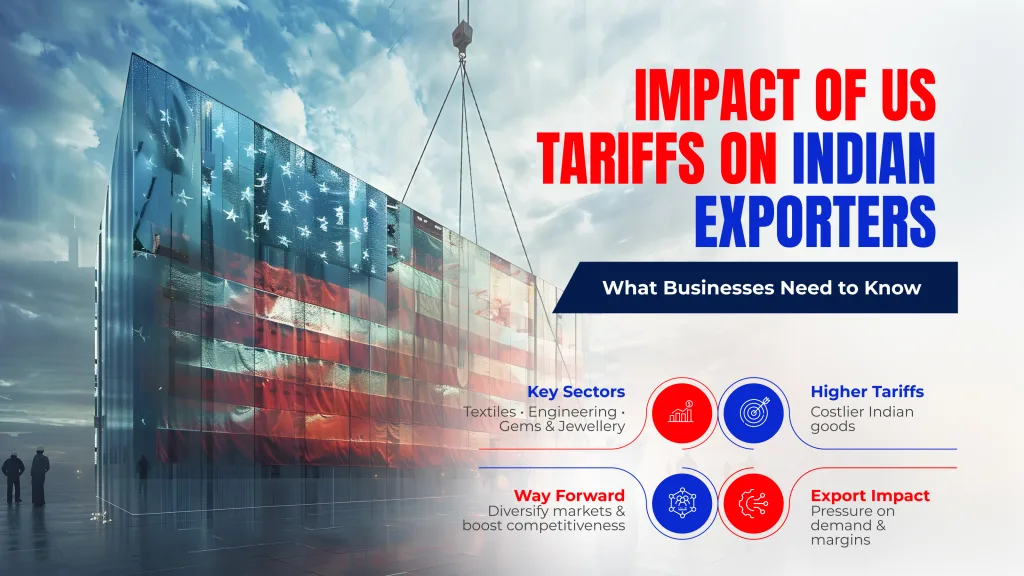
Based on the highly regarded White Paper on Impact of Trump Tariffs on India published by the PHD Chamber of Commerce and Industry in August 2025, the tariffs struck at the heart of India’s export engine. The sectors that faced the highest exposure included:
- Engineering Goods: Ranging from industrial machinery to automotive parts.
- Electronics: A rapidly growing sector that had recently seen a 50.7% compound annual growth rate.
- Pharmaceuticals: India’s critical contribution to global healthcare and generic medicine.
- Gems and Jewellery: A traditional stronghold of Indian craftsmanship.
- Ready-made Garments and Textiles: Highly sensitive to price elasticity due to intense global competition.
While the February 2026 deal brought the rate down to 18%, these sectors still operate in a significantly altered landscape compared to the zero-duty days of the past, necessitating rigorous cost optimization.
The Definitive US tariff on India list
To provide a granular view of the exposure, PHDCCI researchers utilized a price elasticity model (estimated at -0.5) to project the potential financial losses across various commodities when the 25% reciprocal rate was enacted. Below is the summarized US tariff on India list detailing the financial exposure by sector as estimated for FY2026:
- Engineering Goods: $1.8 billion exposure.
- Electronics: $1.4 billion exposure.
- Pharmaceuticals: $986 million exposure.
- Gems and Jewellery: $932 million exposure.
- Apparel / Ready-Made Garments: $500 million exposure.
- Fruits and Vegetables: Exposed value of $331.47 million, with an estimated loss of $31.08 million.
- Tea: Estimated decline of $8.71 million from a base of $92.95 million.
- Jute Manufacturing: Estimated $8.34 million hit on $88.97 million in exports.
- Tobacco: Potential loss of $8.15 million.
- Coffee & Cereals: Minor but noticeable impacts on agri-exports.
The cumulative estimated loss across all affected commodities stood at approximately $8.11 billion. While this figure is substantial, it is crucial to view it through the lens of India’s total economic output.
The Macroeconomic Perspective: Impact of US tariff on India
Headlines often amplify the negative, but data tells the true story. What was the actual macroeconomic impact of US tariff on India?
According to PHDCCI’s economic analysis, the fundamental resilience of the Indian economy cushioned the blow exceptionally well. While $8.1 billion in exports were threatened, this represented only an estimated 1.87% of India’s total global merchandise exports. More importantly, the projected impact on India’s overall Gross Domestic Product (GDP) was a negligible 0.19%.
“The US’ decision to impose a 25% tariff on select Indian exports appears largely symbolic-more than half of the $132 billion trade remains unaffected, and the estimated GDP impact is minimal,” noted PHDCCI leadership. India’s vast domestic market, diversified economy, and rising global competitiveness provided a robust shock absorber, preventing a localized trade dispute from spiraling into a systemic economic crisis.
Micro-Level Reality: Impact of US tariff on Business in India
While the macro economy remained secure, the Impact of US tariff on Business in India- particularly for Micro, Small, and Medium Enterprises (MSMEs)- required immediate and aggressive tactical shifts.
Initially, businesses faced a crisis of margin compression. When a 25% to 50% duty is levied on imports, the end-consumer rarely absorbs the full cost. American buyers demanded that Indian suppliers share the burden, forcing exporters to cut operational costs, delay capital expenditures, or operate at break-even points to retain hard-won market share.
However, Indian businesses showcased remarkable agility. By July 2026, the resilience was evident in the data. Total merchandise exports climbed to $44.20 billion. Engineering exports- the sector with the highest initial exposure- actually recorded a massive 18% year-on-year growth, hitting $12.24 billion in July 2026. Notably, the US remained the absolute top market for Indian engineering goods, bringing in $2.18 billion in that month alone, a 20% YoY increase.
This data proves that while tariffs create friction, they cannot outright stop the flow of high-quality, competitively manufactured Indian goods. Indian businesses adapted by upgrading technology, scaling up production to reduce per-unit costs, and adhering strictly to international compliance standards.
Strategic Framework: How Exporters Can Navigate the New Normal
The reduction of tariffs to 18% in 2026 is a victory, but the era of unquestioned free trade is over. Non-tariff barriers, shifting policies, and geopolitical volatility remain. Drawing from PHDCCI’s extensive research, here is a strategic roadmap for Indian exporters to maintain and grow their footprint in the US and globally:
1. Pricing Agility and Bundling
Exporters must move away from static pricing. Negotiating bundled pricing with major US retail giants like Walmart, Target, and Amazon can help distribute the tariff burden across a wider volume of goods, ensuring that no single product line becomes unprofitable.
2. Value Addition and Premiumization
Competing purely on cost is a race to the bottom when tariffs are active. Indian exporters must pivot to developing premium variants of their products. Whether it is advanced electronics, specialized pharmaceuticals, or high-value organic agri-products, premium goods have lower price elasticity, meaning American consumers will continue to buy them even if prices slightly increase.
3. Geographic Diversification
While the US remains crucial, over-reliance on a single market is a critical vulnerability. The tariff shocks of 2025 underscore the urgent need to redirect trade volumes. Businesses should aggressively explore high-growth corridors in the European Union (EU), Canada, Latin America, and emerging markets in Africa. July 2026 data shows Indian exports to Germany, the UK, and Singapore are already recording high growth
4. Leveraging the iCET Framework
For technology and defense manufacturers, the US-India Initiative on Critical and Emerging Technology (iCET) represents a golden ticket. By aligning with this framework, Indian firms can position themselves as global R&D and innovation hubs, facilitating high-tech, knowledge-driven exports that bypass traditional commodity tariffs.
5. Joint Ventures and On-Shore Production
To circumvent import tariffs entirely, large Indian corporations should explore joint ventures for on-shore production within the United States. Establishing assembly lines or packaging plants in the US can transform a business from a foreign exporter into a localized partner, insulating it from cross-border trade wars.
Conclusion: Turning Disruption into Opportunity
The turbulence of the last two years serves as a masterclass in economic endurance. The impact of US tariff on India tested the mettle of the nation’s manufacturers, yet the data from 2026 unequivocally shows that Indian exporters have not just survived- they have adapted, evolved, and continued to grow.
For Indian businesses, the directive is clear: embrace technological upgrading, diversify your markets, build resilience into your supply chains, and continue delivering the world-class quality that the global market demands.