







In recent years, the global supply chain landscape has witnessed massive restructuring, prompting nations to fortify their domestic manufacturing capabilities. At the forefront of this industrial renaissance in India is the Production-Linked Incentive (PLI) Scheme. But what is pli scheme in the context of the Indian economy? In essence, the Production-Linked Incentive scheme is an ambitious policy initiative introduced by the Government of India in 2020. With an initial cumulative outlay of ₹1.97 lakh crore (approximately USD 26 billion), the scheme provides companies with performance-linked financial incentives based on incremental sales from products manufactured in domestic units.
As an apex organization, the PHD Chamber of Commerce and Industry (PHDCCI) has closely monitored and supported the rollout of this initiative. The scheme signifies a paradigm shift from traditional input-based subsidies to outcome-based rewards. It is specifically designed to attract foreign investment, encourage domestic manufacturers to expand their horizons, reduce import dependencies, and ultimately position India as a formidable global manufacturing hub.
The PHDCCI Perspective: Catalyzing India’s Economic Engine
The PHD Chamber of Commerce and Industry view the pli scheme india as a watershed moment for both large corporations and Micro, Small, and Medium Enterprises (MSMEs). Historically, Indian manufacturers have faced inherent disadvantages ranging from high logistics costs to infrastructural bottlenecks. The PLI framework effectively neutralizes these disabilities by offering direct financial incentives ranging from 4% to 18% on incremental sales over a defined base year.
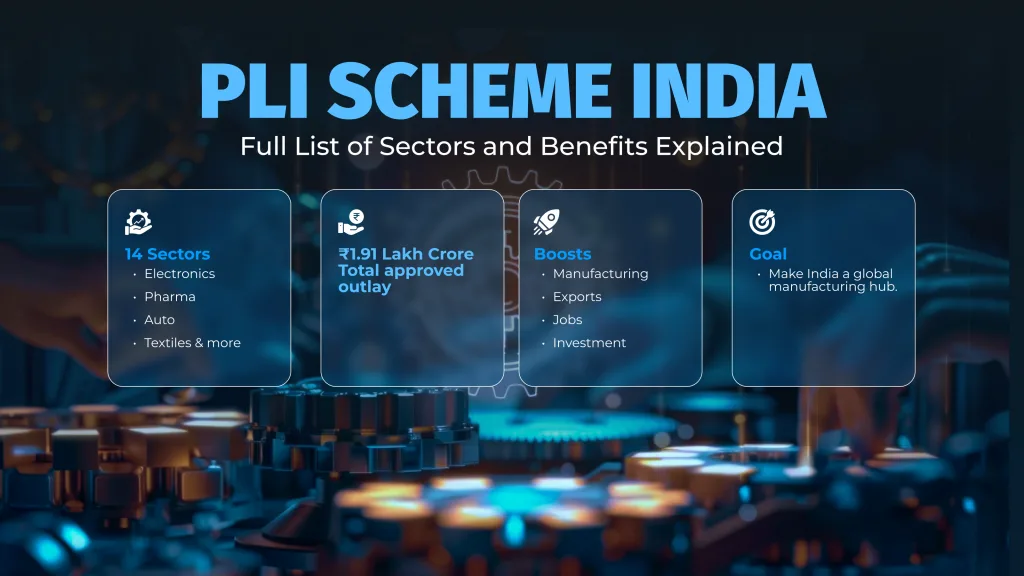
According to recent data up to December 2025, the scheme has demonstrated phenomenal success. Across the strategic sectors, 836 applications have been approved, culminating in cumulative investments exceeding ₹2.16 lakh crore and generating a massive ₹20.41 lakh crore in sales. Most importantly for the socio-economic fabric of the nation, the scheme has generated over 14.39 lakh direct and indirect jobs. PHDCCI firmly believes that for India to achieve its vision of a $5 trillion economy, the continued success and expansion of the PLI framework is non-negotiable.
Sector-by-Sector Deep Dive and Economic Impact
To fully grasp the magnitude of the scheme, PHDCCI emphasizes looking at the on-ground impact within these core sectors.
1. Electronics and IT Hardware
The mobile manufacturing sector has been the crown jewel of the PLI initiative. India has transitioned from being heavily reliant on imported mobile phones to becoming the second-largest manufacturer in the world. Mobile phone imports have plummeted by nearly 77% since FY 2020-21, and today, over 99% of domestic demand is fulfilled locally. The subsequent IT hardware scheme further deepens localization for laptops, servers, and tablets.
2. Pharmaceuticals and Medical Devices
Historically, India has been the “pharmacy of the world,” yet it relied heavily on specific nations for Key Starting Materials (KSMs) and Active Pharmaceutical Ingredients (APIs). The PLI scheme has successfully catalyzed the indigenous manufacturing of 191 bulk drugs, achieving an import substitution of roughly ₹1,785 crore. Furthermore, the localized production of high-end medical devices (implants, imaging systems) has brought global manufacturing standards to Indian shores.
3. Automobiles and Advanced Chemistry Cells
The transition to green mobility is inevitable. With an outlay of ₹25,938 crore for auto components and an additional ₹18,100 crore for ACC batteries, India is building a robust electric vehicle (EV) ecosystem. By March 2024, the automotive PLI initiative had already yielded massive, committed investments, spurring advancements in hydrogen fuel cell technology and battery localization.
4. Textiles and Specialty Steel
While India has traditionally dominated the cotton textile market, global demand has aggressively shifted toward Man-Made Fibers (MMF) and technical textiles. The ₹10,683 crore outlay specifically targets this gap. Similarly, the specialty steel sector aims to reduce the import of high-grade steel used in defense, space, and power sectors.
5. Food Processing and White Goods
The food processing PLI ensures that India’s vast agricultural output is matched with state-of-the-art processing, packaging, and export readiness. In the consumer durables space, the White Goods PLI (focused on ACs and LED lights) has successfully attracted immense investments, shifting the industry from mere assembly to deep component manufacturing.
Understanding the PLI Mechanism: How Are Benefits Calculated?
A major query for businesses transitioning into this ecosystem is how the incentive is fundamentally structured. The scheme operates on a strictly defined set of metrics:
- Base Year: A specific financial year is chosen as the baseline (usually FY 2019-20).
- Minimum Incremental Investment: Companies must commit a predetermined minimum investment in plant, machinery, and equipment. This threshold varies drastically by sector- from as low as ₹2 crore for drones to over ₹250 crore for automotive OEMs.
- Incremental Sales: The cash incentive is calculated purely on the incremental sales of manufactured goods over the base year.
- Domestic Value Addition (DVA): Many sectors require a progressively increasing percentage of local value addition to qualify for payouts in subsequent years.
For industrial entities, calculating these projected benefits requires rigorous financial modeling incorporating capital expenditure plans, capacity utilization rates, and projected export volumes.
Key Benefits for Businesses and the MSME Ecosystem
The Production-Linked Incentive scheme is not strictly an enterprise game. The downstream benefits are profoundly transformative for the entire industrial ecosystem.
1. Enhanced Cash Flows and Margins
The direct cash subsidy (ranging from 4% to 18%) acts as a massive buffer for companies during the initial, capital-intensive years of capacity expansion. This allows Indian manufacturers to price their products competitively on the global stage, effectively neutralizing infrastructural disadvantages.
2. The Anchor-Supplier Dynamic
While large corporations (“Anchor Investors”) often clear the primary thresholds for PLI approvals, they cannot achieve the mandated Domestic Value Addition (DVA) targets in isolation. This creates a massive, indirect opportunity for MSMEs. By integrating into the supply chains of PLI-approved mega-factories- acting as tier-1 and tier-2 suppliers for auto components, electronic sub-assemblies, and pharmaceutical intermediaries- MSMEs experience guaranteed order books and technological upgrades.
3.Fostering a Culture of Innovation
By tying incentives to specific product lines (such as advanced chemistry cells, biosimilars, and complex IT hardware), the government is forcing the industry to move up the value chain. Companies are now investing heavily in R&D to meet the rigorous technological criteria set out in the scheme guidelines.
4. Global Value Chain Integration
As global brands look for a “China Plus One” strategy to de-risk their supply chains, the PLI scheme provides the exact financial and structural stability foreign entities need to set up base in India. This influx of foreign direct investment brings along global best practices, stringent quality standards, and deep integration into international markets.
How to Apply: A Quick Roadmap for Industries
For businesses aiming to leverage this historical opportunity, the PHD Chamber of Commerce and Industry recommends a systematic approach:
- Eligibility Assessment: Scrutinize the specific guidelines issued by the respective nodal ministry. Understand the minimum investment thresholds and the list of eligible products. Remember, only registered corporate entities (Private Limited, Public Limited) are typically eligible; partnerships and proprietorships are generally excluded.
- Detailed Project Report (DPR): Prepare an exhaustive DPR outlining the intended capital expenditure, sourcing strategy for raw materials, projected domestic value addition, and employment generation matrix.
- Application via Project Management Agencies (PMAs): The government has appointed specialized PMAs (like IFCI, SIDBI, or MECON) to scrutinize applications, monitor investments, and disburse incentives. Applications must be submitted through the designated PLI portals.
- Compliance and Auditing: Maintain impeccable records of incremental sales and investments. Avoid common pitfalls, such as miscalculating base-year revenues or including ineligible product lines in the claim applications.
The Road Ahead: Phasing and Future Transitions
As we look toward the future, it is critical to note that the PLI schemes have designated sunset clauses. Most schemes are expected to begin phasing out their incentive windows by mid-2026 to 2028. However, this is not the end of industrial support. The government is already working on successor frameworks, such as dedicated Component Manufacturing Schemes, aimed at deepening the value chain in sub-assemblies and raw materials.
The PHD Chamber of Commerce and Industry (PHDCCI) remains committed to bridging the gap between policymakers and the industry. We continually advocate for the rationalization of compliance burdens, faster disbursal of approved incentives, and the potential inclusion of newer sectors like space-tech, toys, and niche chemicals in future tranches.
Conclusion
The PLI Scheme is unarguably one of the most structural and aggressive industrial policies in India’s post-liberalization history. By directly linking state support to measurable, incremental output, the government has ensured accountability while simultaneously supercharging economic growth. From mobile phones and pharmaceuticals to solar modules and electric vehicles, the PLI scheme is rewriting the DNA of Indian manufacturing.
For corporate leaders, investors, and MSMEs, the time for hesitation has passed. Understanding the sector outlays, strictly adhering to the eligibility criteria, and rapidly executing expansion plans will define the winners of India’s manufacturing decade.