





The Micro, Small, and Medium Enterprises (MSME) sector is the undisputed backbone of the Indian economy. Contributing significantly to the nation’s GDP, employment generation, and socio-economic development, an MSME in India is far more than just a business-it is the heartbeat of self-reliance and grassroots innovation. However, despite their massive contribution, navigating the landscape of MSME financing has historically been a complex challenge for many business owners. The “credit gap” has been a persistent hurdle, but recent reforms, digitalization, and proactive government interventions have fundamentally transformed how credit is disbursed.
For businesses looking to scale, understanding the myriad of MSME loans, subsidies, and credit guarantees is no longer optional-it is a strategic necessity. This comprehensive guide breaks down how MSME finance works today, exploring the best MSME government schemes and MSME funding options available to propel your enterprise toward unprecedented success.
The Foundation: Udyam Registration and the MSME Certificate
Before diving into any financing avenue, the very first prerequisite is formalizing your business identity. You cannot unlock the vast ecosystem of government support without a formal MSME registration.
Since July 2020, the government has mandated the Udyam registration portal as the single, paperless window for classification. Registering your business here yields an official MSME certificate (the Udyam Registration Number or URN), which acts as your passport to institutional credit and subsidies.
The scale of this formalized ecosystem is staggering. As of June 2026, official data reveals that a massive 4,71,55,579 (4.72 crore) MSMEs are officially registered on the Udyam portal. The demographic breakdown showcases the sheer grassroots nature of this sector: 98.9% (over 4.66 crore) of these are micro-enterprises, while small enterprises account for just over 1% (approx. 4.9 lakh), and medium enterprises stand at a mere 37,042. Geographically, Maharashtra leads the nation with 7.33 million registered enterprises.
Possessing this certificate unlocks immense MSME benefits. It makes you eligible for priority sector lending, lower interest rates, protection against delayed payments, waiver of stamp duty, and concession in electricity bills. More importantly, your Udyam profile is integrated directly with your GST and ITR records, allowing lending institutions to cross-verify your turnover and investment declarations instantly. If your classification is stale or inaccurate, it is highly advised to fix it before applying for credit.
How Does MSME Financing Work in India?
Traditionally, securing business capital required heavy collateral-real estate, fixed deposits, or heavy machinery. This alienated micro and small founders who had strong cash flows but lacked hard assets. Today, MSME financing in India is transitioning rapidly from collateral-based lending to cash-flow-based lending.
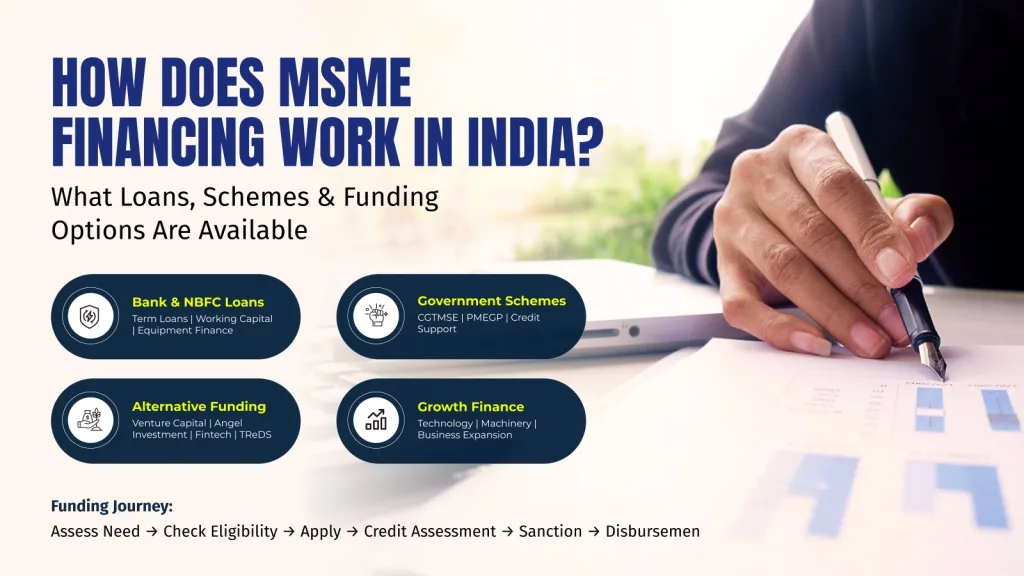
Here is how the funding pipeline generally operates:
- Assessment of Need: Businesses identify whether they need Working Capital (to manage day-to-day operations, inventory, and payroll) or Term Loans (for capital expenditure like buying machinery or expanding facilities).
- Choosing the Channel: Businesses can approach Public Sector Banks (PSBs), Private Banks, Non-Banking Financial Companies (NBFCs), or emerging digital Fintech platforms.
- Applying through Schemes: Instead of taking a standard commercial loan with high-interest rates and collateral requirements, an MSME applies under specific MSME loan schemes where the government acts as a guarantor or provides a capital subsidy.
- Credit Appraisal: Thanks to the Account Aggregator (AA) framework and digital footprints, lenders now assess the health of a business by analyzing MSME GST returns, ITRs, and digital banking trails rather than solely relying on physical property audits.
Top MSME Government Schemes for MSME Loans
The Government of India, alongside the Small Industries Development Bank of India (SIDBI) and the Ministry of MSME, has engineered several landmark MSME government schemes to de-risk lending for banks and ensure liquidity for founders.
1. Credit Guarantee Fund Trust for Micro and Small Enterprises (CGTMSE)
If you need a substantial loan but have zero collateral, the CGTMSE is your premier route. Established jointly by the Ministry of MSME and SIDBI, this scheme provides a credit guarantee to financial institutions. This means if a business defaults, the government trust steps in to cover up to 75% to 85% of the loss, thereby encouraging banks to lend freely without demanding physical property.
In a massive boost for MSME growth, the maximum credit ceiling under the CGTMSE framework was raised to ₹10 Crore (up from ₹5 Crore) effective April 1, 2025. The scheme covers both term loans and working capital facilities. Borrowers pay an Annual Guarantee Fee (AGF) which ranges from 0.37% to 1.35% depending on the loan amount, with special 10% discounts for women entrepreneurs, SC/ST founders, and ZED-certified units.
2. Pradhan Mantri Mudra Yojana (PMMY)
Mudra is the ultimate micro-credit architecture designed to “fund the unfunded.” It provides collateral-free loans for income-generating activities in manufacturing, trading, and services. The loans are categorized into different tiers based on the business’s life stage:
- Shishu: Loans up to ₹50,000 for early-stage setups and vendors.
- Kishore: Loans from ₹50,001 to ₹10 Lakh for small service/retail units.
- Tarun & Tarun Plus: Loans from ₹10 Lakh up to ₹20 Lakh for light manufacturing and repeat borrowers requiring higher capital limits.
Mudra loans carry zero processing fees for the Shishu and Kishore categories, and the National Credit Guarantee Trustee Company (NCGTC) secures the lenders.
3. Prime Minister’s Employment Generation Programme (PMEGP)
Unlike standard loan guarantees, PMEGP offers an upfront capital subsidy-free money (margin money) injected directly by the government to help you set up a new enterprise. Managed by the Khadi and Village Industries Commission (KVIC), it is the flagship credit-linked subsidy program for new greenfield projects.
- Maximum Project Cost: Up to ₹50 Lakh for manufacturing units and ₹20 Lakh for service sector units.
- Subsidy Slabs: Urban general category applicants receive a 15% subsidy, while rural applicants receive 25%. Special categories (women, SC/ST, OBC, minorities, ex-servicemen, hill areas) receive a robust 25% in urban areas and 35% in rural areas.
The applicant only needs to bring in a 5% to 10% contribution, and the rest is financed via a bank loan.
4. Stand-Up India Scheme & MCGS-MSME
The Stand-Up India Scheme facilitates bank loans between ₹10 Lakh and ₹1 Crore for greenfield projects setup specifically by Scheduled Caste (SC), Scheduled Tribe (ST), or women entrepreneurs. It ensures that diverse founders have dedicated access to institutional capital.
For established manufacturers looking at heavy capacity expansion, the newer MCGS-MSME scheme guarantees term loans specifically for plant and machinery purchases up to an impressive ₹100 crore.
Exploring Diverse MSME Funding Options Beyond Traditional Banking
While government-backed bank loans form the core of the lending ecosystem, modern enterprises have access to a rich tapestry of alternative MSME funding options:
- Trade Receivables Discounting System (TReDS): Cash flow blockages due to delayed payments from large corporate buyers or PSUs are a notorious problem. TReDS is an RBI-regulated electronic platform where MSMEs can auction their trade receivables (invoices) to multiple financiers. This allows the MSME to get cash immediately at a competitive discount rate, effectively transferring the risk of collection to the bank.
- NBFCs and Fintech Lenders: Non-Banking Financial Companies and digital lenders use alternate data underwriting (analyzing UPI transaction volumes, POS swipes, and supply chain health) to disburse unsecured working capital loans rapidly. Though interest rates may be slightly higher than traditional banks, the speed of deployment and lack of bureaucracy make them highly attractive for urgent cash flow needs.
- Venture Debt and Peer-to-Peer Lending: For high-growth, tech-enabled MSMEs, relying purely on traditional debt might choke early cash flows. Venture debt is increasingly penetrating the upper layers of the medium enterprise segment, providing patient capital for scaling operations.
Fueling MSME Export and Long-Term MSME Growth
Achieving long-term MSME growth requires looking beyond domestic borders. The government is heavily incentivizing MSME export through targeted initiatives. Schemes like the Market Development Assistance (MDA) and the Capacity Building of First-Time MSME Exporters (CBFTE) offer vital financial assistance. These funds help businesses participate in international trade fairs, obtain global quality certifications (like the ZED – Zero Defect Zero Effect framework), and subsidize export credit insurance premiums. A valid MSME certificate is your gateway to accessing these export subsidies, ensuring that Indian products can compete globally on both price and quality.
The Role of PHDCCI in Amplifying MSME Finance Opportunities
At the PHD Chamber of Commerce and Industry (PHDCCI), we recognize that information asymmetry is the biggest roadblock to financial access. The PHDCCI MSME Committee aggressively advocates for policy rationalization with regulatory bodies and the Ministry of MSME.
Our regular capacity-building workshops, B2B summits, and financial literacy camps are designed to bridge the gap between financial institutions and grassroots entrepreneurs. We help demystify the complex compliance required for MSME registration, guide businesses through the intricate paperwork of various MSME loan schemes, and foster dialogues that result in tangible policy upgrades.
Conclusion
The architecture of MSME finance in India has never been more robust or accessible. From micro-loans under Mudra to heavy machinery financing and collateral-free term loans up to ₹10 Crore under CGTMSE, the ecosystem is primed to support ambition at every scale.
The blueprint for success is clear: Secure your Udyam registration, maintain impeccable GST and digital transaction records, and align your capital needs with the right MSME government schemes. As India marches toward its macro-economic goals, empowering the MSME sector is the most critical catalyst. At PHDCCI, we remain committed to ensuring that every viable business plan finds the MSME funding it deserves. Now is the time to leverage these instruments and scale your business to new heights.