






India’s macro-industrial transformation is entering a decisive phase driven by the convergence of enterprise trade, digital technology, and inclusive economic policy. For decades, Micro, Small, and Medium Enterprises (MSMEs) have served as the fundamental backbone of national production, employment, and regional economic development. Yet, these enterprises have routinely faced persistent structural frictions, including fragmented supply networks, high customer acquisition costs, delayed payments, and severely constrained access to institutional working capital. Digital Public Infrastructure (DPI) is systematically dismantling these historical barriers. By building open, interoperable, and non-monopolistic digital rails-spanning digital identity, unified payments, consent-based data sharing, and open protocol commerce-India is creating an equitable architecture for enterprise trade. At the PHD Chamber of Commerce and Industry (PHDCCI), we recognize that the expansion of open networks across B2B trade channels represents a fundamental paradigm shift. DPI is moving small businesses from peripheral, closed platform ecosystems into the mainstream of nationwide and global industrial supply chains.
The Structural Friction in Legacy MSME Supply Chains
Micro, Small, and Medium Enterprises represent the irreplaceable bedrock of the Indian industrial landscape. Official economic indicators show that over 7.22 crore registered MSME units support more than 31.66 crore livelihoods across the nation, contributing approximately 30.1% to India’s Gross Domestic Product (GDP), 35.4% to total manufacturing output, and over 45.73% to national exports. Despite their massive collective footprint, individual small enterprises have historically operated at a distinct competitive disadvantage compared to large corporate conglomerates. Traditional B2B procurement and supply chain management have long been constrained by high systemic friction, market concentration, and restrictive commercial practices.
Legacy commercial marketplaces operate almost exclusively on centralized, closed-loop platform models. Sellers must register on private platforms, paying steep commission fees that erode already thin operating margins, while buyer discovery remains restricted within isolated proprietary walled gardens. Furthermore, Indian MSMEs face an estimated institutional credit gap exceeding ₹25 lakh crore to ₹30 lakh crore. Traditional commercial banking relies heavily on collateral-backed underwriting. Lacking fixed physical assets, small businesses are frequently excluded from timely working capital financing despite holding valid purchase orders and verified trade invoices.
Compounding these operational vulnerabilities are long payment cycles and extended credit terms that severely strain small business balance sheets. Delayed receivables force MSMEs to curtail production capacity, reject bulk supply contracts, or turn to high-cost informal credit markets to manage daily cash flows. Additionally, severe information asymmetry leaves small manufacturing clusters in tier-2, tier-3, and rural regions disconnected from direct market access to major corporate original equipment manufacturers (OEMs) and international procurement houses, forcing them to rely on multi-tiered networks of commission agents.
Unpacking the Open Network Paradigm: The Building Blocks of DPI
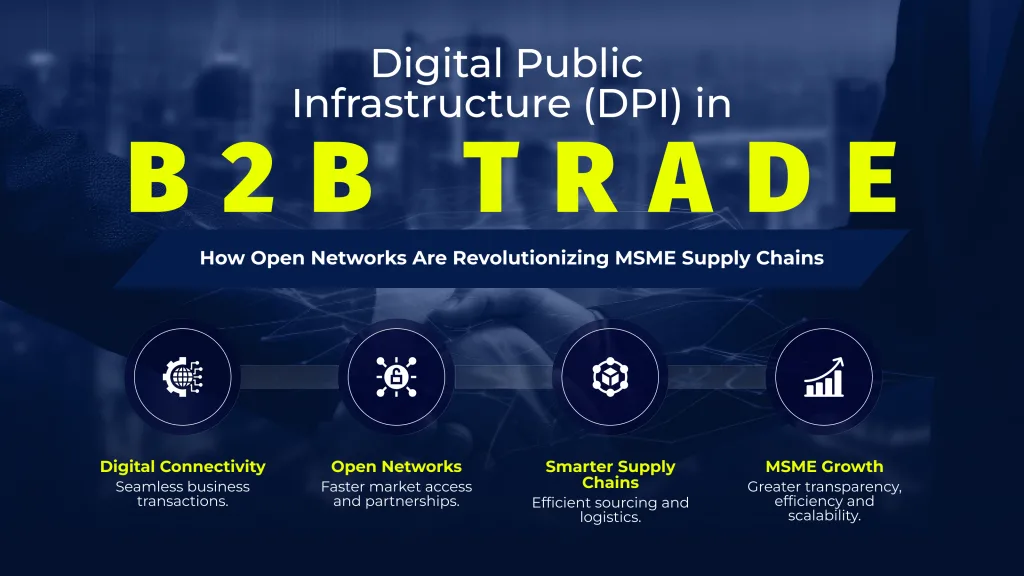
Digital Public Infrastructure addresses supply chain inefficiencies by unbundling the components of enterprise trade into open, interoperable protocols. Rather than forcing buyers and sellers onto a single private platform, DPI provides standardized public digital rails where diverse technological applications can interact seamlessly. The foundational components of this architecture operate synergistically across enterprise commerce, credit distribution, and transaction settlement.
The Open Network for Digital Commerce (ONDC) serves as a primary engine for open trade unbundling. Developed as a public protocol initiative under the Department for Promotion of Industry and Internal Trade (DPIIT), ONDC transforms e-commerce from a platform-centric model to an open network framework. Under this open architecture, an enterprise buyer registered on one application can discover, negotiate, and transact with a seller registered on a completely different seller application. According to official data published by the Press Information Bureau (PIB), ONDC has processed cumulative Gross Merchandise Value (GMV) exceeding ₹16.41 lakh crore, supporting over 11 lakh Micro and Small Enterprises that account for 44.8% of cumulative order value. Expanding ONDC into B2B trade allows enterprise buyers to perform bulk discovery, request custom pricing quotes, execute purchase contracts, and coordinate logistics across an open, competitive marketplace.
Complementing open trade rails is the Open Credit Enablement Network (OCEN) working alongside the Reserve Bank of India’s Account Aggregator (AA) framework. Credit enablement through DPI shifts cash-flow financing from asset-backed underwriting to verifiable transaction data. OCEN acts as a standardized protocol connecting digital platforms, borrowing MSMEs, and institutional lenders. Through the consent-based Account Aggregator network, small businesses can securely share digitally verified bank statements, GST filings, and e-invoicing data in real time. Lenders can evaluate business health instantly, enabling short-term, low-ticket purchase order financing and invoice discounting directly within the supply chain workflow.
To directly alleviate cash flow constraints from delayed payments, India established the Trade Receivables Discounting System (TReDS). TReDS is an institutional electronic platform where MSMEs can discount their trade receivables from corporate buyers, central public sector enterprises (CPSEs), and government bodies through competitive bidding by multiple financiers. As highlighted in policy assessments by PHDCCI, mandatory settlement mandates on TReDS platforms for CPSE-MSME transactions are accelerating payment cycles, strengthening MSME liquidity, and enforcing financial discipline across corporate supply chains. Integrating TReDS with open trade networks provides automated, invoice-backed liquidity immediately upon goods dispatch.
How Open Networks Are Transforming MSME Supply Chain Dynamics
Digital Public Infrastructure in B2B trade
The implementation of Digital Public Infrastructure across enterprise trade channels yields distinct operational benefits across the supply chain value chain, fundamentally altering how small businesses discover markets, secure capital, handle fulfillment, and manage compliance.
Democratic market access and discovery represent a dramatic departure from proprietary platform lock-in. Open protocols eliminate the need for MSMEs to maintain separate seller accounts across multiple private B2B marketplaces. By listing once on an ONDC-enabled seller application, a small manufacturer becomes visible across the entire national network. This unbundled discovery drastically lowers buyer acquisition costs, allows specialized regional producers to access national markets, and prevents dominant platform monopolies from controlling search algorithms or levying excessive intermediate fees.
Simultaneously, the sector is experiencing a structural shift from collateral-based to data-driven cash-flow lending. Historical constraints in MSME financing stemmed from a lack of verifiable business records. DPI bridges this trust deficit through the integration of digital identity, unified payments, and consent-based data sharing. A comprehensive survey conducted by the India SME Forum on Digitalisation in Indian MSMEs revealed that over 53.8% of Indian MSMEs have adopted digital tools, with 41.4% of digitized enterprises reporting a direct sales increase between 21% and 30%. As transaction data becomes digitized across e-invoicing platforms and open networks, real-time revenue flows replace fixed physical collateral as underwriting criteria, unlocking accessible working capital.
Supply chain resilience is further enhanced through logistics and warehousing unbundling. Open networks extend beyond product catalogs to unbundle third-party fulfillment services. Enterprise buyers and sellers can evaluate and select independent freight forwarders, cold-chain operators, and hyper-local warehousing facilities directly through open APIs. This flexibility allows MSMEs to optimize transport costs, improve delivery fulfillment speeds, and maintain operational continuity during localized supply chain disruptions.
Furthermore, DPI frameworks integrate essential business functions-including verified digital identities via Aadhaar e-KYC, secure digital signatures via eSign, instant payments through UPI, and automated GST tax invoicing-directly into transaction workflows. Automating trade verification reduces processing overheads, minimizes contract disputes, and streamlines regulatory compliance for small businesses.
PHDCCI’s Strategic Interventions and Advocacy
As a premier apex chamber representing industry and trade, the PHD Chamber of Commerce and Industry (PHDCCI) works actively at the intersection of government policy, technological adoption, and MSME capacity building. Recognizing Digital Public Infrastructure as a central driver of future national trade competitiveness, PHDCCI leads targeted initiatives to help enterprises navigate open digital architectures.
Through detailed policy representations submitted to the Ministry of Commerce and Industry, Ministry of MSME, and Ministry of Finance, PHDCCI advocates for regulatory frameworks that lower entry barriers, streamline TReDS compliance, and expand open network adoption across regional industrial clusters. The Chamber’s dedicated initiatives, accessible through the PHDCCI Knowledge Hub, conduct workshops and technical training sessions across manufacturing corridors to educate small enterprise owners on ONDC onboarding, Account Aggregator integration, and digital risk management.
To ground advocacy in empirical evidence, the Chamber regularly conducts economic sentiment analyses, including the PHDCCI SME Market Sentiment Index (SMESI), to evaluate digital adoption levels, track working capital constraints, and deliver actionable insights to key policy architects. Leveraging specialized platforms like the PHDCCI Research Bureau Services, the Chamber connects MSMEs with foreign buyers, technology developers, and trade finance institutions, promoting cross-border trade readiness and sustainable business models.
Strategic Vision for Open B2B Commerce
To maximize the benefits of Open Networks and Digital Public Infrastructure, enterprise leaders and MSME owners must align their operational strategies with digital-first trade practices. Businesses should transition legacy procurement and sales channels toward ONDC-compatible protocols to lower customer acquisition costs and expand supplier networks. Implementing robust digital record-keeping systems-such as automated inventory management and structured GST filings-creates the verifiable digital footprint necessary to unlock consent-based cash-flow financing via Account Aggregators.
Active participation in TReDS platforms and OCEN-enabled cash-flow lending products lowers borrowing costs, optimizes receivables management, and stabilizes daily operations. Concurrently, building enterprise cybersecurity frameworks, securing API connections, and maintaining strict compliance with data protection standards ensures that commercial transactions across open network ecosystems remain protected against digital vulnerabilities.
The expansion of Digital Public Infrastructure across B2B trade marks a fundamental evolution in how industrial supply chains operate. By replacing closed, proprietary platforms with open, non-monopolistic networks, India is building an efficient, transparent, and resilient commercial architecture. The PHD Chamber of Commerce and Industry remains dedicated to supporting Indian enterprise through this transition-empowering MSMEs to convert digital access into sustainable long-term competitiveness on both domestic and global stages.