






India continues to hold its position as the fastest-growing major economy in the world, and the India GDP growth rate trajectory heading into 2026 reaffirms this narrative. With real GDP growth for FY 2025-26 revised upward to 7.6% by the Reserve Bank of India, robust consumption demand, strong services momentum and a resilient manufacturing base, India’s growth story stands out amid an uncertain global economic environment. As PHD Chamber of Commerce and Industry (PHDCCI), we track these macroeconomic indicators closely to help Indian businesses, investors and policymakers plan for the year ahead.
This article offers a comprehensive, data-backed look at where the India GDP growth rate today stands, how it compares with the India GDP growth rate in the last 10 years, what the India GDP growth rate 2025 trends signalled, and a sector-wise forecast for 2026 and beyond.
India’s GDP Growth Rate Today: Where We Stand
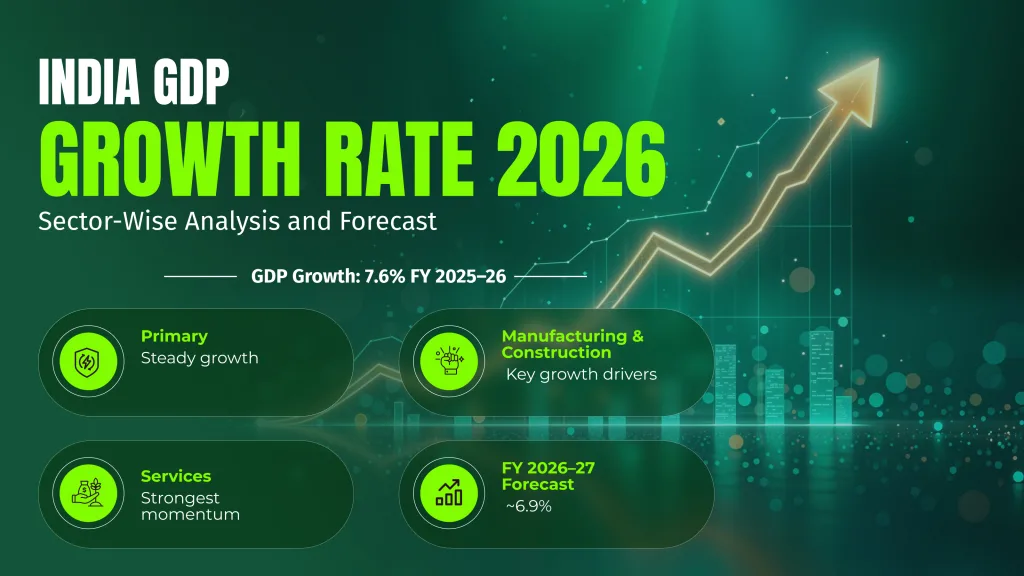
India’s economy has entered FY 2025-26 with considerable strength. According to the Reserve Bank of India, the India GDP growth rate for FY 2025-26 has been revised upward multiple times through the year – from an initial estimate of 6.7%, to 7.4%, and finally to 7.6%, as domestic demand, services activity and manufacturing expansion outperformed expectations. The Ministry of Statistics and Programme Implementation (MOSPI) has corroborated this momentum, with real GDP growing 7.8% in Q1 FY26 and an impressive 8.2% in Q2 FY26, the sharpest quarterly expansion in recent years.
This acceleration is particularly notable given that the government’s own Economic Survey had initially projected FY26 growth in the 6.3-6.8% range, while global agencies were more conservative. The stronger-than-expected outturn reflects buoyant private consumption, a pickup in gross fixed capital formation, GST rationalisation, softening inflation, and monetary easing by the RBI.
For FY 2026-27, the RBI currently projects growth moderating to around 6.9%, reflecting the fading of cyclical tailwinds and continuing global uncertainties, even as India retains its position as the fastest-growing large economy within the G20.
India GDP Growth Rate 2025: A Recap
The India GDP growth rate 2025 period (spanning FY 2024-25 and calendar year 2025) was a story of moderation followed by resurgence. Real GDP growth for FY 2024-25 came in at 6.5%, the slowest pace in four years, weighed down by softer manufacturing activity and a temporary pullback in government capital expenditure during the general election cycle. Nominal GDP for the year touched approximately ₹330.68 lakh crore, registering 9.8% growth.
However, the second half of FY25 and the early quarters of FY26 saw a sharp turnaround. Multilateral agencies revised their outlook upward through late 2025 and into 2026: the IMF lifted its FY26 forecast to 7.3%, the World Bank projected 6.5% for 2026 citing strong consumption and GST reform benefits, and the OECD raised its 2025 forecast to 6.7%. This upward revision cycle across institutions- the IMF, World Bank, OECD, Moody’s and S&P- reflects growing confidence in India’s structural growth drivers: a young workforce, digital public infrastructure, rising formalisation, and sustained capital expenditure by the government.
India GDP Growth Rate Last 10 Years: The Bigger Picture
Understanding the India GDP growth rate last 10 years helps put the current momentum into context. Over the past decade, India’s growth path has been anything but linear- shaped by demonetisation, GST implementation, the pandemic shock, and a strong post-pandemic recovery.
The average India GDP growth rate over this decade works out to roughly 6-7%, even after accounting for the pandemic-induced contraction, a resilience that has helped India climb from the world’s 10th-largest economy to among the top five, and, per IMF data, nearly double its GDP in dollar terms over ten years, from about USD 2.1 trillion in 2015 to over USD 4 trillion in 2025.
An important structural shift is also underway: MOSPI has recently rolled out a new GDP series with base year 2022-23, replacing the earlier 2011-12 base. Under this new series, real GDP for FY 2023-24 and FY 2024-25 stood at 7.2% and 7.1% respectively, a methodological recalibration that businesses and analysts should track going forward, as it will become the reference series for GDP growth rate reporting from 2026 onward.
Sector-Wise Analysis: What’s Driving Growth in 2026
A granular, sector-wise view is essential to understand the quality and sustainability of India’s growth. The economy is conventionally analysed across three broad sectors: Primary, Secondary and Tertiary, and each has played a distinct role in FY26’s growth acceleration.
1. Primary Sector (Agriculture, Forestry, Fishing, Mining)
The primary sector has shown steady, if moderate, growth. In Q2 FY 2025-26, the primary sector recorded real GVA growth of around 3.1-3.5%, supported by favourable monsoon conditions and healthy rabi crop prospects. While agriculture continues to be a stabilising force for rural consumption, its share in overall GDP has been gradually declining as the economy diversifies, a trend PHDCCI views as consistent with India’s structural transformation toward manufacturing and services.
2. Secondary Sector (Manufacturing, Construction, Utilities)
The secondary sector has emerged as a standout performer in FY26, growing at approximately 8.1% in Q2 FY 2025-26. Within this:
- Manufacturing expanded by around 9.1%, buoyed by the Production Linked Incentive (PLI) schemes, import substitution, and rising capacity utilisation across sectors such as electronics, automobiles, textiles and pharmaceuticals.
- Construction grew even faster, at roughly 7.2-9.4%, reflecting strong government and private capital expenditure in infrastructure, housing and urban development.
- Electricity, gas and utilities posted more moderate growth, in line with industrial power demand trends.
This manufacturing and construction-led resurgence aligns with PHDCCI’s long-standing advocacy for labour-intensive manufacturing, ease of doing business reforms, and deeper integration into global value chains as key levers for India’s growth.
3. Tertiary Sector (Services)
Services remain the single largest contributor to India’s GDP, accounting for well over half of total output, and continue to be the fastest-growing segment- expanding by around 9.2% in Q2 FY 2025-26. Within services, Financial, Real Estate and Professional Services posted particularly strong growth of over 10%, driven by robust credit growth, a buoyant capital market, IT and business process outsourcing demand, and expanding digital financial services. Trade, hotels, transport and communication also contributed meaningfully, aided by resilient urban and rural consumption.
Expenditure-Side Drivers
On the demand side, private final consumption expenditure grew close to 7.9% in Q2 FY26, up sharply from the prior year, while gross fixed capital formation (investment) also accelerated, supported by government capex and improving private sector investment sentiment. Exports have shown resilience despite global trade headwinds, including US tariff actions, underlining India’s relatively low dependence on external trade as a share of GDP.
India’s GDP Growth Forecast: 2026 and Beyond
Looking ahead, forecasts for India’s GDP growth rate remain broadly optimistic, though agencies differ slightly in their projections:
- RBI: 7.6% for FY 2025-26; approximately 6.9% for FY 2026-27
- IMF: 7.3% for FY26, moderating to around 6.4% over the following two fiscal years
- World Bank: 6.5% for 2026
- OECD: 6.2% for 2026
- Moody’s: 6.4% for 2026 and 6.5% for 2027
- S&P Global: 6.5% for FY26 and 6.7% for FY27
- United Nations (WESP 2026): 6.6-6.7% for the current and coming year
While the exact figures vary based on methodology and timing, the consensus is clear: India is expected to remain among the fastest-growing large economies globally through 2026 and beyond, even as growth moderates from FY26’s exceptional pace toward a more sustainable long-term trend of 6.5-7%.
PHDCCI’s own research has consistently highlighted India’s path toward becoming a USD 5 trillion economy by FY 2026-27 and a USD 7 trillion economy by 2030, powered by structural reforms, digital infrastructure, favourable demographics, and sustained public investment. Sectors identified by PHDCCI as key growth engines for the years ahead include agriculture and food processing, infrastructure, textiles and apparel, pharmaceuticals, defence manufacturing, electronics, renewable energy, fintech and semiconductors.
Key Risks and Watch Points
Despite the encouraging outlook, businesses should stay alert to several risk factors that could influence the India GDP growth rate trajectory in 2026:
- Global trade tensions and tariff actions, particularly from the United States, which could affect export-oriented sectors
- Currency and bond market volatility, with the rupee facing periodic pressure
- Inflation trends, which, while currently within the RBI’s target band, remain sensitive to food and energy price shocks
- Geopolitical developments, including regional conflicts that can disrupt energy supplies and investor sentiment
- Base effects, as FY26’s high growth print makes FY27 comparisons statistically more challenging
Conclusion
India’s growth story remains one of resilience, diversification and structural transformation. With the India GDP growth rate for FY 2025-26 running at its fastest pace in years, and sector-wise momentum broad-based across manufacturing, construction and services, the outlook for 2026 remains firmly positive. As global institutions continue to revise their India forecasts upward, businesses, investors and policymakers have a clear signal: India’s domestic demand-led growth model, supported by reforms and infrastructure investment, is well-positioned to sustain its position as the world’s fastest-growing major economy.
PHDCCI remains committed to tracking these trends closely through its ongoing research initiatives and will continue to advocate for policies that strengthen ease of doing business, capital expenditure, and export competitiveness to help India realise its full growth potential on the path to Viksit Bharat @2047.