



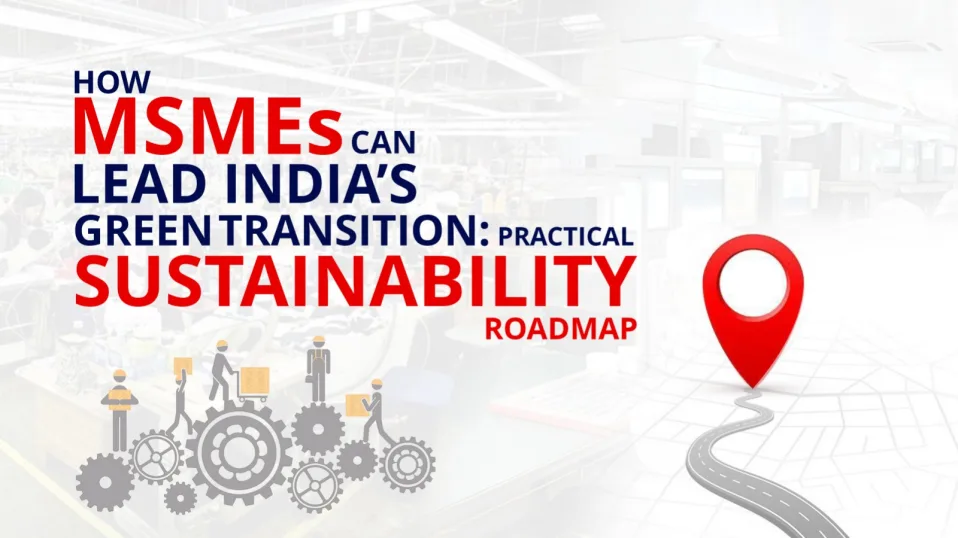
India’s 6.3 crore MSMEs (Micro, Small and Medium Enterprises) are pivotal to the country’s climate and development narrative. These enterprises, encompassing manufacturing, services, and trade sectors, collectively contribute around 30% to India’s GDP and about 45% of total exports. Employing over 25 crore people, MSMEs hold immense potential not just as economic drivers but as key agents of sustainable green growth. Positioned at the crossroads of energy consumption, resource use, and innovation, MSMEs can transform India’s green transition from a regulatory challenge into a robust opportunity for competitive advantage and inclusive growth.
The need of the hour is to equip MSMEs with a practical sustainability roadmap. This roadmap must blend policy incentives, financial mechanisms, technology access, skill development, and market linkages into an actionable plan that drives green transformation while sustaining business competitiveness.
Why MSMEs Matter for Green Growth
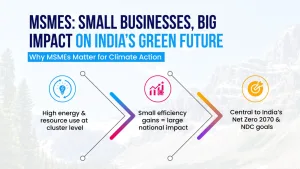
MSMEs form the bedrock of India’s industrial landscape. Their widespread presence across manufacturing clusters means that improving energy efficiency, reducing waste, and adopting cleaner technologies at the MSME level yields outsized economy-wide climate benefits. Despite their importance, MSMEs frequently face structural barriers such as limited access to long-term green financing, lack of technical expertise, and fragmented information about relevant government schemes and environmental standards. They also grapple with pressures to maintain price competitiveness in a highly cost-sensitive environment.
Overcoming these barriers is essential for India to meet its net-zero emission target by 2070 and fulfill its Nationally Determined Contribution (NDC) commitments under the Paris Agreement. Importantly, this green transition cannot compromise the competitiveness or growth of MSMEs; rather, it must align with their business goals.
Emerging Green Policy and Finance Landscape for MSMEs
India’s climate finance ecosystem is evolving to support MSMEs in adopting sustainable, energy-efficient practices. Several government programs and financial institutions have begun converging around green objectives tailored to MSME realities:
- MSME Sustainable (ZED) Certification Scheme promotes “Zero Defect, Zero Effect” manufacturing practices by offering graded certifications with subsidies for certification costs and technology upgrades. This motivates MSMEs to embed sustainability into their core operations.
- RAMP (Raising and Accelerating MSME Performance) Scheme and the MSE Cluster Development Programme bolster competitiveness by supporting infrastructure improvements and common facilities integrating clean technologies and circular economy principles.
- On the finance front, SIDBI (Small Industries Development Bank of India) plays a critical role by channeling multilateral credit lines and domestic funds into energy efficiency, cleaner production, and renewable energy projects. Innovations such as blended finance, partial risk-sharing, and interest subvention for green loans aim to reduce capital costs and attract greater MSME participation.
PHDCCI’s Role in Catalysing the Transition
PHDCCI is at the forefront of catalyzing MSME sustainability initiatives through platforms like the “Global Summit on Sustainability – MSMEs: Small Businesses, Big Impact.” These forums gather policymakers, financiers, technologists, corporates, and MSME representatives to co-create solutions, share best practices, and advocate for enabling policy ecosystems.
PHDCCI also promotes ecosystem-level interventions by encouraging the development of sustainability parks, MSME-focused innovation centers, and leveraging emerging green credit and carbon markets to incentivize early movers. Collaboration with bodies such as the Bureau of Energy Efficiency (BEE) and SIDBI helps PHDCCI in guiding MSMEs through navigation of schemes, capacity-building efforts, and financing access.
Five-Pillar MSME Sustainability Roadmap
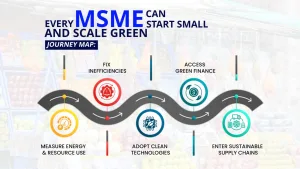
PHDCCI recommends a structured MSME sustainability roadmap based on five mutually reinforcing pillars:
- Strategy, Compliance, and Baseline Assessment
- Energy Efficiency and Clean Energy Adoption
- Resource Efficiency and Circular Operations
- Green Finance and Partnerships
- Skills Development and Digital Tools
This roadmap underscores that sustainability is not a one-time project but a progression through maturity stages—from compliance and data gathering to optimization, substitution, circular business models, and ultimately innovation-driven green products and services.
Pillar 1: Strategy, Compliance, and Baseline Assessment
MSMEs must begin their sustainability journey by understanding their current environmental footprint and regulatory environment:
- Identify applicable environmental regulations related to clearances, waste management, extended producer responsibility (EPR), and sector-specific standards.
- Establish simple baselines for energy use, water consumption, material usage intensity, and waste generation at the process or unit level using meters and utility bills.
- Tools like SIDBI’s Sustainability Perception Index help benchmark MSMEs’ sustainability preparedness, revealing that around 40% of MSMEs have already initiated green measures balancing profitability with environmental responsibility.
PHDCCI can amplify these tools through local chapters and sector committees, enabling members to benchmark and set realistic environmental improvement targets.
Pillar 2: Energy Efficiency and Clean Energy
Energy expenses can dominate operating costs (20–40%) in energy-intensive MSME clusters like foundries, textiles, ceramics, and food processing. Targeted energy efficiency interventions often generate savings between 15–30%, with rapid payback periods of 1–3 years, improving competitiveness vividly:
- BEE’s SME Programme and cluster-level energy efficiency initiatives offer audits, technology demos, and innovative financing such as ESCO models, where repayments derive from energy savings.
- SIDBI channels credit lines and risk-sharing facilities to back investments in efficient equipment, process upgrades, and rooftop solar systems.
- MSMEs should prioritize straightforward efficiency improvements such as efficient motors, compressors, lighting, heat recovery, and process optimization before advancing to on-site renewable generation.
PHDCCI collaborates with these agencies to scale cluster-level energy efficiency initiatives, disseminate sector-specific guidelines, and negotiate preferential bulk procurement for MSMEs.
Pillar 3: Resource Efficiency and Circularity
MSMEs can achieve significant cost savings and open new revenue channels through circular economy practices:
- Material substitution and reuse, waste minimization, and redesign for longer product life or easier recycling.
- Efficient water usage and shared infrastructure for effluent treatment and recycling via cluster development programmes and common facility centres.
- ZED certification and related policy incentives explicitly reward waste reduction, sustainable materials use, and pollution prevention.
PHDCCI’s outreach can boost MSME awareness and scheme utilisation, facilitating access to shared resources and technology demonstration facilities.
Key Government Schemes MSMEs Should Leverage
A multitude of targeted schemes aim to support MSME’s sustainability; however, awareness and uptake remain challenges. PHDCCI bridges this gap by curating and disseminating scheme information tailored by sectors, regions, and investment sizes, thus helping MSMEs build stacked incentive project pipelines.
| Focus Area | Scheme / Initiative | Relevance for MSMEs |
| Cleaner, defect-free manufacturing | MSME Sustainable (ZED) Certification Scheme | Promotes zero defect and sustainable production, subsidies for certification, capacity building |
| Energy efficiency & renewables | BEE SME Programme & clusters | Energy audits, technology demonstrations, ESCO finance |
| Performance & infrastructure | RAMP Scheme, MSE Cluster Development | Supports competitiveness, cleaner tech infrastructure |
| Green finance | SIDBI 4E, PRSF, green loan lines | Dedicated finance, partial risk sharing, interest subvention for green projects |
| Ease of doing business | MSME SAMBANDH portal | Portal for Public procurement facilitation |
Financing the MSME Green Transition
Green investments in MSMEs often face hurdles like high upfront costs, perception of technology risks, and unclear payback timelines. Despite their intrinsic viability, addressing these requires:
- Customized financial products
- Risk-sharing mechanisms that reduce lender exposure
- Closer partnerships between financiers, technology providers, and MSME clusters
A successful example is the SIDBI performance-risk-sharing facility, which supported energy efficiency projects totaling ₹141 crore in FY 2022-23, signaling growing financial sector confidence.
PHDCCI advocates for:
- Expanded, simplified interest subvention schemes for verified green loans.
- Facilitating bankable project pipelines by connecting MSMEs, ESCOs suppliers and banks and standardizing documentation to lower transaction costs.
Building Skills, Digital Readiness, and Data Capabilities
Sustainability increasingly demands data-driven measurement, reporting, and verification. MSMEs require skills in basic carbon accounting, resource mapping, and digital tools to track and improve environmental performance.
Despite training initiatives by public and private entities, MSMEs often struggle to access sector-specific, high-quality learning resources. PHDCCI can:
- Design modular training programs covering energy management, resource efficiency, ESG basics, and sustainability reporting in local languages.
- Collaborate with digital solution providers to pilot affordable resource tracking and reporting tools, generate case studies, and demonstrate benefits of sustainability for cost savings and market access.
Supply Chain Pressure and Market Opportunities
Large domestic and global buyers are increasingly embedding environmental criteria into procurement policies, supplier codes, and ratings. While this often translates into additional compliance documentation for MSMEs, it also opens doors to stable, premium markets and long-term relationships.
At PHDCCI’s sustainability summits, corporate leaders underscore the necessity of integrating sustainability with core business functions and using CSR and supplier development programs to uplift MSME partners. Collaborative efforts mediated by PHDCCI focus on technology upgrades, environmental audits, workforce training, and co-investment models to share value along supply chains.
PHDCCI’s Action Agenda for MSMEs
To effectively position India’s 6.3 crore MSMEs as leaders in the green transition, PHDCCI proposes a focused action agenda:
- Establish sector-specific Sustainability Working Groups within existing MSME committees to identify barriers, curate best practices, and co-design solutions with stakeholders.
- Develop or support Sustainability Parks and MSME innovation hubs clustering green infrastructure, R&D, and incubation services.
- Launch a PHDCCI Green MSME Rating or recognition program aligned with national accreditation frameworks like ZED and BEE to spotlight sustainable champions and attract investments.
By embedding sustainability into core MSME engagement and advocacy, PHDCCI aims to help MSMEs turn climate challenges into engines of job creation, innovation, and inclusive growth.
This comprehensive roadmap and the concerted efforts of PHDCCI, along with government and financial institutions, reveal a promising path for MSMEs to lead India’s green transition—turning climate responsibility into sustained economic growth.