

The excitement of signing that contract for a major international deal is unparalleled! Probably, your high-end organic skincare or precision-engineered components are to win new markets, and the profit margins grip even the biggest investors’ hearts. Then, panic sets in: your cargo is under customs scrutiny, and the local authorities are asking for official documents.
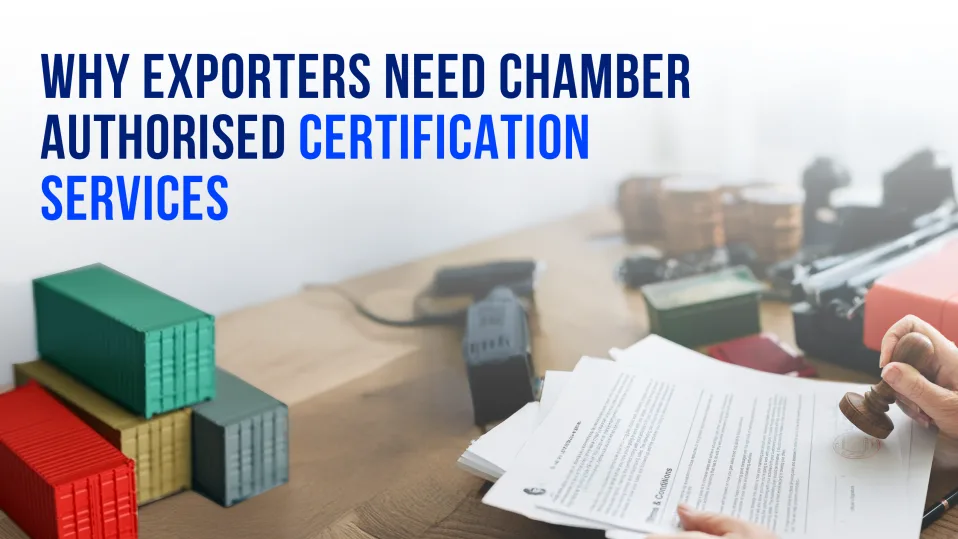
This is not fiction, but the life of exporters that isolate themselves from the benefits of Chamber-Authorised Certification Services from bodies like PHDCCI. Trust remains the primary driving force in global trade, and these certifications are the least to say when it comes to being the necessary ones. They are not merely the additional forms to be filled; they are your international movement visa, granting you the zero-tariff advantages and protection from penalties. The trust barrier between countries will undoubtedly be one of the hardest to overcome for a company hoping to grow from a local player to a global giant.
The Gatekeepers of Trust in Global Trade
In domestic trading, an invoice is enough to document the transaction between a buyer and a seller who are operating in the same legal environment. However, if your merchandise goes beyond the borders, the international legal case, treaties, and protective policies are already in place. Customs officials, no matter whether they are in Dubai, New York, or Amsterdam, do not know you personally and hence, do not trust your statement that the goods are made in India or that the product is harmless for the consumers.
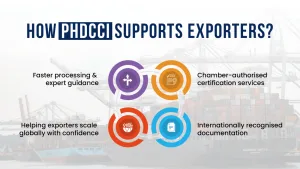
This point is right when PHDCCI comes into the picture, being an accredited Chamber of Commerce. As an authorised Chamber of commerce, we hold a global position as impartial third parties with peculiar powers, and the imprint of a Chamber on your papers is a formal certification of your company’s integrity. Organisations such as PHDCCI work as trustworthy intermediaries between you, the exporter, and the government of the receiving country. Our mark is a universal signal to customs officers that the information has been verified by a trusted organisation, bringing in additional international recognition, so your cargo ideally does not turn into a “ghost ship” and get stuck in a foreign port.
Your Product’s Economic Nationality
The Certificate of Origin (COO) from PHDCCI is the top-ranking document among the necessary export documents that cannot be disputed. To put it more straightforwardly, this paper proves the economic belonging of your goods. Though it sounds plain, it has a tremendous and complex impact on your profits. The Certificate of Origin has two major types, and having a clear-cut understanding of their differences is often what makes a winning exporter as opposed to a failing one. In the first place, the Non-Preferential Certificate of Origin is the document that simply tells where the goods were grown, made, or manufactured. This document is required by importing countries mostly for the purpose of keeping statistics, controlling the amounts of goods that can be imported, or applying measures to prevent dumping. The thing is, if you don’t have this document, your goods may not even be allowed to enter the country at all, no matter how good they are or how low their price is.
Another advantage lies in the Non-Preferential Certificate of Origin issued by PHDCCI in a speedy and contactless manner by DGFT while maintaining transparency. To promote trade, governments generally sign Free Trade Agreements (FTAs) and then, very often, bring down import duties to nothing. However, to avail of the zero per cent rate, it is necessary to demonstrate very clearly that your goods are from a partner country.
It is not enough to just claim it on an invoice; there has to be evidence. Just think about the huge potential offered by such agreements as the India-UAE Comprehensive Economic Partnership Agreement (CEPA). The deal brings Indian exporters the benefit of accessing the glamorous UAE market at zero duty for the labour-intensive sectors such as gems, jewellery, textiles, leather, and footwear.
Failure of Certification
Failing to obtain a Preferential COO may result in your buyer being liable for a standard import duty, which could amount to five per cent or even higher. In the case of a large shipment with a value of one million dollars, this would mean a saving of fifty thousand dollars and thus create a competitive pricing position for you. It gives you the option of either increasing your margins or reducing prices to the level of competitors who do not make use of these agreements. The same situation applies in North America; the USMCA agreement permits the importation of qualifying vehicles without any duties. This stands in sharp contrast to non-compliant imports that are likely to face steep tariffs. The difference is sometimes as much as the whole profit margin of the vehicle. Thus, PHDCCI’s sanctioned COO is like a golden ticket at the end of the rainbow that supports all these claims. If it is absent, your buyer has to pay the full tax, and you have lost your competitive advantage in a global market that is very sensitive to price changes.
The High Cost of Cutting Corners
On the other hand, a mistake in the area of international trade certification will cost a lot, and it will be tough to recover reputationally, besides losing a huge amount of money. A real-life scenario is a chilling reminder of the consequences of corner-cutting. Think of an electrical equipment maker in Delhi who unceremoniously lost the export deal because an DGFT authourised chamber like PHDCCI did not attest the contract and documents properly. The dimension of the fiasco was immense. By the time the goods reached Europe, the customs had already rejected them due to the lack of validation. The manufacturer had to take back the shipment to India, which cost him a fortune in reverse logistics, fines, and penalties. Additionally, the financial loss was followed by the loss of a client’s trust, which is, to a great extent, the hardest thing to recover.
The situation occasionally happens when companies in the UK are imposed record fines for non-compliance in the export area, which shows that authorities are quick to punish even small errors in documentation. Customs officials are the ones who determine if you can pass or not, and if your COO has made various mistakes, such as wrong product descriptions, wrong tariff codes, or unstamped documents, you are liable to incur a triple penalty. First, you will lose your right to pay less duty, which would come as an unwelcome surprise to your buyer, who now has to pay full duty. Second, your shipment would be delayed, and the storage fees at the ports would be so high that they could destroy your profits in just a few days. Third, you might get fined for making false declarations because they were accidental.
Certificate of Free Sale as a Validator of Safety
In addition to the product’s origin, there is another aspect of the safety and legality of the goods that is examined. The Free Sale Certificate is the document that provides this information. While the COO identifies the place of origin of a product, a Certificate of Free Sale identifies what the product is, especially that it is safe and legal. For instance, this is very significant for the exporters of cosmetics, food supplements, and medical devices. To illustrate, if you want to sell your new range of organic face creams in Latin America or the Middle East, the local authorities there would like to determine whether this product is actually sold in your country or is an inferior product produced solely for export. A Certificate of Free Sale issued or stamped by a PHDCCI states that your product can be sold freely in the open market of your country and is in conformity with the local regulations.
The Danger of Self-Certification
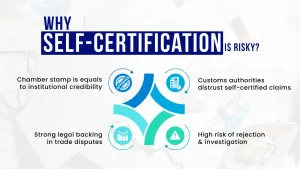
Self-certification is allowed in some very specific, advanced trade agreements, but for the vast majority of global trade, a Non-Preferential Certificate of Origin requires a trusted third party like PHDCCI, which is authorised by DGFT, Ministry of Commerce and Industry, Govt. of India. Customs authorities view self-made documents with deep suspicion. A stamp from PHDCCI is an institutional seal of credibility. It says that an independent body has reviewed your evidence, such as purchasing invoices or manufacturer declarations, and agrees with your claim. Furthermore, legal precedents have shown that a verified COO from a relevant authority is powerful evidence in court. In disputes regarding duty exemptions, a valid certificate can prevent authorities from denying benefits to the importer, acting as your legal safety net.
Conclusion: A Strategic Asset for Global Growth
In the big picture of the world economy, your product is only as good as the paper that goes with it. Chamber-authorised certification services are not merely unavoidable bureaucratic processes. They are your company’s allies that give you power. They open up the markets that would be otherwise closed, reduce the costs significantly by means of tariff cuts, and add a very strong layer of trust with your foreign partners. Therefore, make sure to contact a reputable Chamber like PHDCCI, which has been serving Industry, Trade & Commerce since 1905 as a trusted Voice of Industry & Trade, as you get ready for your next export victory.