




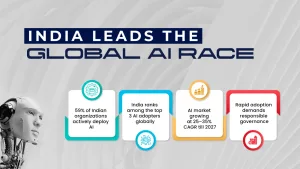
India stands at the threshold of an artificial intelligence revolution. With 59% of Indian organisations actively deploying AI—leading global markets like Singapore, the UAE, and China—the nation has positioned itself as a frontrunner in technological innovation. According to IBM’s Global AI Adoption Index, India ranks among the top three countries worldwide in AI implementation, surpassing traditional technology powerhouses.
The PHD Chamber of Commerce and Industry (PHDCCI), representing over 150,000 businesses across diverse sectors, recognizes that this rapid AI adoption brings both tremendous opportunities and significant ethical challenges. As India’s AI market accelerates toward a projected 25-35% CAGR through 2027, the imperative for robust ethics and governance frameworks has never been more critical.
The Current State of AI Adoption in Indian Businesses
Impressive Growth Trajectory
India’s AI landscape in 2024-2025 presents a compelling picture of technological transformation:
- 73% of Indian businesses plan to increase AI applications by 2025, significantly exceeding the global average of 52%
- 48% adoption rate across key industries in FY 2024, with expectations of an additional 5-7% growth in FY25
- Over 80% of Indian organisations are exploring autonomous AI agents, indicating a shift toward more sophisticated AI implementations
- 67% of firms report that generative AI has positively impacted all phases of software development
According to NASSCOM’s AI Adoption Index 2.0, India’s aggregate AI maturity score stands at 2.47 on a 4-point scale, with 87% of companies positioned in the middle stages of AI adoption maturity. Manufacturing and telecom sectors have already progressed to the “Expert” stage, while other sectors are rapidly catching up.
Sectoral Leadership and Challenges
The Banking, Financial Services and Insurance (BFSI) sector, Consumer Packaged Goods (CPG), and retail industries are leading AI adoption efforts. However, 30% of organizations still face limited AI skills and expertise, while 27% find AI projects too complex to integrate and scale effectively. These challenges underscore the need for comprehensive governance frameworks that can guide businesses through the complexities of ethical AI implementation.
Understanding the Ethical Dimensions of AI
The Core Ethical Challenges
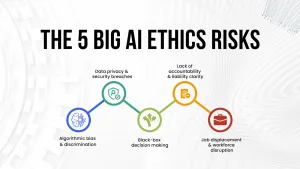
PHDCCI’s engagement with member enterprises reveals five critical ethical concerns that Indian businesses must address:
- Algorithmic Bias and Discrimination
AI systems trained on historical data often perpetuate existing societal biases. Many industry experts have highlighted that most of the AI datasets originate in Western contexts, created predominantly by specific demographic groups, and are then applied to India’s diverse population. This creates a fundamental mismatch that can exacerbate social inequalities rather than reduce them. The Ministry of Electronics and Information Technology (MeitY) has explicitly required that AI models be stripped of bias and discrimination, yet implementation remains challenging.
- Data Privacy and Security Vulnerabilities
With AI systems requiring massive datasets for training and operation, data privacy emerges as a paramount concern. The absence of a comprehensive AI-specific regulatory framework has intensified worries about privacy violations. According to recent data, Indians lost close to Rs 7,000 crore to online scams in the first five months of 2025 alone, demonstrating the urgent need for stronger protections.
- Transparency and Explainability
Many AI algorithms operate as “black boxes,” making it difficult for users and even developers to understand decision-making processes. The lack of transparency becomes particularly concerning when personal data is involved or when AI systems make decisions affecting people’s livelihoods, creditworthiness, or legal standing.
- Accountability and Liability
Determining accountability for AI-driven decisions presents complex challenges. When autonomous systems cause harm or make errors, questions arise: Who is responsible—the developer, the deployer, or the organization using the AI? India’s current legal framework doesn’t adequately address these accountability concerns.
- Job Displacement and Workforce Transformation
The International Monetary Fund estimates that approximately 40% of jobs globally may be affected by AI, with India facing a relatively lower risk of 30% due to its predominantly agricultural economy. Nevertheless, the concern about AI-driven unemployment requires proactive workforce development and reskilling initiatives.
India’s Evolving AI Governance Framework
The Indian government has taken significant strides in establishing ethical AI governance:
IndiaAI Mission (2024)
Backed by over Rs 10,300 crore ($1.24 billion) in funding over five years, the IndiaAI Mission encompasses seven pillars, with “Safe and Trusted AI” as a central component. The mission emphasizes safety, accountability, and ethical practices in AI development and deployment.
India AI Governance Guidelines (November 2024)
Unveiled by the Ministry of Electronics and Information Technology, these comprehensive guidelines provide:
- Seven guiding principles (Sutras) for ethical and responsible AI
- Six pillars of AI governance with actionable recommendations
- Short, medium, and long-term action plans
- Practical guidelines for industry, developers, and regulators
The guidelines adopt a “Do No Harm” principle as their philosophical foundation, emphasizing human-centric AI development that safeguards individuals while promoting innovation.
Key Regulatory Approaches:
- Risk-Based Classification: AI systems are categorized based on their potential impact, with high-risk applications in finance, healthcare, and hiring receiving stricter oversight
- Voluntary Compliance Framework: The government favors industry-led compliance efforts over heavy-handed regulation during the nascent stage of ecosystem development
- Transparency Requirements: Emphasis on making AI value chains more transparent, from data collection through deployment
- Existing Law Application: Current regulations on information technology, data protection, and consumer protection are being leveraged to govern AI applications
International Collaboration and Standards
India’s participation in the Global Partnership on Artificial Intelligence (GPAI) demonstrates its commitment to ethical AI governance on the international stage. Partnerships with organizations like UNESCO have facilitated the AI Readiness Assessment Methodology, helping India develop robust frameworks that incorporate ethical considerations into national and state-level AI strategies.
The Chamber’s Commitment to Responsible Innovation
PHDCCI has consistently positioned itself as a catalyst for responsible AI adoption among Indian businesses. Our recent initiatives demonstrate this commitment:
Capacity Building Programs
In November 2024, PHDCCI organized an immersive workshop on “AI Tools for Everyday Business,” equipping 50 delegates from diverse sectors with practical skills for ethical AI implementation. The workshop emphasized that AI has evolved from an emerging trend to an essential business necessity, requiring businesses to adopt it responsibly.
Industry-Government Collaboration
PHDCCI’s conference on “Harnessing AI to Combat Frauds and Counterfeits in Retail & E-commerce” brought together government leaders, industry experts, and technology specialists. The event highlighted that with proper governance, AI can serve as a “first line of defense” against fraud, catching irregularities that human oversight might miss.
PHDCCI’s Framework for Ethical AI Adoption
Based on our engagement with over 150,000 member companies, PHDCCI recommends a comprehensive approach to ethical AI governance:
- Establish Clear Governance Structures
Organizations must create cross-functional AI governance committees combining legal, technical, and ethical expertise. These committees should:
- Define accountability frameworks for AI deployment
- Establish ethical guidelines aligned with national standards
- Monitor AI systems for bias, privacy violations, and security vulnerabilities
- Ensure compliance with evolving regulations
- Implement Privacy-by-Design Principles
Privacy considerations must be integrated from the earliest stages of AI development. This includes:
- Robust data encryption and security measures
- Transparent data usage policies
- Regular privacy impact assessments
- Mechanisms for user consent and control over personal data
- Conduct Regular Audits and Bias Mitigation
Periodic audits of AI models are essential to detect biases, inefficiencies, and security vulnerabilities. Organisations should:
- Invest in diverse, representative training datasets
- Implement bias detection and mitigation techniques
- Ensure AI models don’t reinforce social prejudices
- Document and explain AI decision-making processes
- Foster Transparency and Explainability
Businesses must prioritise transparent AI systems that stakeholders can understand and trust:
- Develop clear documentation of AI system capabilities and limitations
- Create mechanisms for explaining AI-driven decisions
- Label under-tested or unreliable AI models appropriately
- Maintain open communication with consumers about AI usage
- Invest in Workforce Development
Organizations should adopt a hybrid approach to AI implementation:
- Upskill existing workforce for AI-augmented roles
- Focus on human-AI collaboration rather than complete automation
- Provide training on AI ethics and responsible usage
- Create new roles that leverage uniquely human capabilities
Implementation Roadmap for Indian Businesses
Short-Term Actions (0-12 Months)
- Establish AI Ethics Committee: Form a dedicated team responsible for ethical AI oversight.
- Conduct AI Inventory: Document all existing and planned AI systems
- Risk Assessment: Classify AI applications based on potential impact and risk levels
- Policy Development: Create internal AI ethics policies aligned with national guidelines
- Employee Training: Initiate awareness programs on responsible AI usage
Medium-Term Initiatives (1-3 Years)
- Implement Governance Tools: Deploy technical solutions for bias detection, privacy preservation, and content authentication.
- Stakeholder Engagement: Create channels for consumer feedback on AI systems
- Partnerships: Collaborate with industry associations, academic institutions, and technology providers
- Certification: Pursue ethical AI certifications and compliance frameworks
- Continuous Monitoring: Establish systems for ongoing AI performance and ethics auditing
Long-Term Strategic Goals (3-5 Years)
- AI Center of Excellence: Build internal expertise in ethical AI development
- Industry Leadership: Contribute to sector-specific ethical AI standards
- Innovation for Good: Develop AI solutions addressing societal challenges
- Global Alignment: Align practices with international ethical AI frameworks
- Sustainable AI: Implement environmentally conscious AI infrastructure
Overcoming Implementation Challenges
For Strategy and Governance Gaps:
- Leverage industry frameworks developed by NASSCOM, NITI Aayog, and MeitY
- Participate in chamber-led knowledge-sharing initiatives
- Engage with sector-specific working groups
For Skills Shortages:
- Partner with educational institutions for talent development
- Utilize government-funded skill development programs
- Implement peer learning and mentorship programs within industry associations
For Data Complexity:
- Adopt data standardization practices
- Invest in modern IT infrastructure and cloud solutions
- Collaborate with technology service providers for data management
For Ethical Concerns:
- Follow the India AI Governance Guidelines
- Implement industry best practices for bias mitigation
- Maintain transparent communication with stakeholders
The Path Forward
As India accelerates its AI adoption journey, PHDCCI envisions a future where ethical considerations and governance frameworks are not compliance burdens but strategic advantages. Organisations that prioritise responsible AI will:
- Build Consumer Trust: Transparent, ethical AI practices create lasting customer relationships
- Gain Competitive Advantage: Early adopters of ethical frameworks will be better positioned for future regulations
- Attract Global Partnerships: International collaborators increasingly require ethical AI commitments
- Contribute to National Goals: Align with India’s vision of becoming a global leader in responsible AI
- Drive Sustainable Innovation: Ethical AI ensures long-term business viability and social benefit
Conclusion
India’s leadership in AI adoption presents an extraordinary opportunity to demonstrate that technological innovation and ethical responsibility can coexist and reinforce each other. With 70% of firms reporting that AI integration met or surpassed ROI estimates, the business case for AI is clear. Now, the imperative is to ensure this growth is sustainable, inclusive, and ethically grounded.