




India’s logistics sector is changing fast. Rising fuel costs, delivery delays, and pressure to cut emissions have pushed businesses to rethink how goods move and where they are stored. At the same time, government initiatives like the National Logistics Policy and PM GatiShakti are encouraging better planning, lower costs, and cleaner operations across the supply chain.
Two changes stand out in this shift. Electric fleets are becoming common in last-mile delivery, while smart warehouses are replacing manual storage with data-driven systems. Together, they are helping logistics players reduce costs, improve efficiency, and lower environmental impact.
This article explains how electric vehicles and smart warehousing are shaping sustainable logistics in India, the benefits they offer, and the challenges that still need to be addressed.
What Is Sustainable Logistics in the Indian Context?
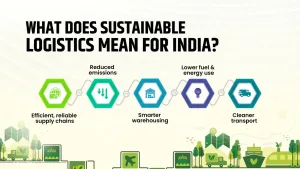
Sustainable logistics in India focuses on moving and storing goods in a way that reduces fuel use, cuts emissions, and improves efficiency across the supply chain.
It combines cleaner transport, smarter warehousing, better data use, and coordinated infrastructure planning.
The goal is to lower logistics costs, reduce environmental impact, and support reliable, long-term growth for businesses operating across diverse regions and cities.
The Role of Electric Fleets in Sustainable Logistics
Electric fleets are becoming a core part of India’s push toward cleaner and more efficient logistics. They are especially important in cities, where delivery volumes are high and pollution concerns are growing. The shift from fuel-based vehicles to electric ones is helping logistics operators control costs while reducing environmental impact.
Shift from ICE to Electric Vehicles in Logistics
Logistics fleets have traditionally depended on diesel and petrol vehicles. This is now changing, particularly in last-mile delivery. Electric 2-wheelers and 3-wheelers are increasingly replacing internal combustion engine vehicles for short-distance routes. Their suitability for urban use makes them a practical option for daily delivery operations.
Cost and Efficiency Advantages of Electric Fleets
Electric vehicles offer lower running costs compared to diesel or CNG vehicles. Electricity is cheaper than fuel, and EVs require less maintenance due to fewer moving parts. For high-usage delivery routes, this results in a lower total cost of ownership over time, making electric fleets financially attractive.
Growth of EVs in Last-Mile and Urban Distribution
E-commerce and quick-commerce platforms have accelerated EV adoption in cities. High delivery frequency and predictable routes suit electric vehicles well. As charging and battery-swapping networks expand, electric fleets are becoming reliable for daily operations, supporting faster and cleaner urban logistics.
Government Policy Support for Electric Logistics
Government policies play a major role in pushing electric mobility across India’s logistics sector. These policies focus on lowering costs, improving infrastructure, and encouraging large-scale adoption of electric vehicles for commercial use.
National Logistics Policy and Cost Reduction Goals
The National Logistics Policy aims to make logistics more efficient and affordable. One of its key goals is to reduce India’s logistics cost from around 13–14% of GDP to single-digit levels. Electric fleets support this goal by lowering fuel expenses, reducing maintenance costs, and improving delivery efficiency, especially in urban areas.
PM E-DRIVE Scheme and EV Incentives
The PM E-DRIVE scheme has replaced earlier incentive programs and focuses on commercial electric vehicles. It supports the rollout of charging infrastructure and encourages bulk adoption by fleet operators. By targeting high-usage vehicles, the scheme helps electric logistics scale faster and become financially viable.
State and City-Level EV Push
Several states and city authorities offer additional incentives for electric commercial vehicles. These include reduced road taxes, registration benefits, and priority access in low-emission zones. Such local support makes electric fleets more attractive for last-mile and intra-city logistics operations.
Charging and Energy Infrastructure for Electric Fleets
Charging and energy access are critical for the smooth operation of electric logistics fleets. As adoption increases, infrastructure models are evolving to support high vehicle utilisation and reduce downtime.
Battery Swapping Models for Commercial Fleets
Battery swapping has become a practical solution for 2-wheelers and 3-wheelers used in delivery operations. Instead of waiting for vehicles to charge, drivers can swap depleted batteries for fully charged ones within minutes. This model supports continuous operations and suits high-frequency urban delivery routes.
Captive Charging at Warehouses
Many logistics hubs and warehouses are now setting up captive charging stations. These facilities allow fleets to charge vehicles during loading and unloading cycles. In some cases, charging infrastructure is combined with rooftop solar systems, helping reduce electricity costs and improve energy reliability.
Infrastructure Gaps and Limitations
Despite progress, challenges remain. Charging coverage on highways is still limited, especially for larger electric trucks. Grid capacity constraints and uneven charging access across regions can affect fleet planning and route efficiency, slowing wider adoption beyond cities.
Smart Warehousing: The Second Pillar of Sustainable Logistics
Smart warehousing is transforming how goods are stored, handled, and dispatched in India’s logistics sector. Warehouses are no longer passive storage spaces. They are becoming active fulfilment centres that use technology to improve speed, accuracy, and sustainability.
What Makes a Warehouse “Smart”?
A smart warehouse uses digital systems, automation, and connected devices to manage operations in real time. Technologies such as warehouse management systems, sensors, and automation tools help track inventory, control workflows, and reduce manual intervention. This improves visibility and decision-making across daily operations.
Why Smart Warehousing Is Growing in India?
The rapid growth of e-commerce and faster delivery expectations have pushed warehouses to improve efficiency. High order volumes, frequent returns, and time-bound deliveries require better coordination and accuracy. Smart warehousing helps meet these demands while controlling costs and reducing errors.
Shift from Manual to Grade A Warehouses
India is seeing a steady shift from Grade B and C warehouses to Grade A facilities. These modern warehouses offer better layouts, higher ceilings, improved safety standards, and technology-ready infrastructure. Grade A warehouses support automation, energy efficiency, and scalable operations, making them suitable for sustainable logistics models.
Core Technologies Powering Smart Warehousing
Smart warehousing relies on a mix of digital and automated technologies that work together to improve efficiency, accuracy, and sustainability. These tools help warehouses handle higher volumes while reducing errors, energy use, and manual effort.
AI and Data-Driven Decision Making
Artificial intelligence helps warehouses analyse large volumes of operational data in real time. AI tools support demand forecasting, slotting decisions, and workforce planning. By predicting order patterns and peak periods, warehouses can reduce delays, avoid overstocking, and improve order fulfilment speed.
IoT, Sensors, and Real-Time Monitoring
Internet of Things (IoT) devices connect different parts of warehouse operations. Sensors track temperature, humidity, inventory movement, equipment usage, and safety conditions. This real-time visibility helps prevent spoilage, monitor compliance, and respond quickly to operational issues.
Automation, Robotics, and AS/RS
Automation reduces reliance on manual handling. Technologies such as autonomous mobile robots, automated guided vehicles, and automated storage and retrieval systems speed up picking, sorting, and storage. These systems reduce human error, improve safety, and allow warehouses to operate efficiently around the clock.
Sustainability Benefits of Smart Warehousing
Smart warehousing supports sustainability by improving how resources are used, how people work, and how waste is managed. These benefits go beyond efficiency and directly contribute to lower environmental impact and safer operations.
Energy Efficiency and Lower Emissions
Smart warehouses use energy more efficiently through automated lighting, optimised cooling systems, and data-driven equipment usage. Real-time monitoring helps avoid unnecessary power consumption, which lowers emissions and reduces electricity costs.
Improved Safety and Reduced Human Risk
Automation and smart monitoring reduce the need for manual handling in risky areas. Robots and guided vehicles take over heavy or repetitive tasks, while sensors help identify unsafe conditions. This lowers accident rates and improves workplace safety.
Reduced Waste and Inventory Losses
Accurate inventory tracking and better forecasting reduce overstocking, spoilage, and damage. Smart systems ensure faster movement of goods and better storage conditions, which helps minimise waste and product loss across operations.
Comparison: Indian Logistics Landscape Then and Now
India’s logistics sector has changed significantly over the past few years. Earlier, operations were largely manual, fuel-dependent, and fragmented. Today, policy support, technology adoption, and sustainability goals are reshaping how goods move and where they are stored. The shift toward electric fleets and smart warehousing highlights this transformation clearly.
| Aspect | Earlier Landscape (Around 2020) | Current Direction (2025) |
| Last-Mile Delivery Fleet | Mostly diesel and petrol vehicles | Electric-first approach using 2W, 3W, and small commercial EVs |
| Warehouse Type | Grade B/C warehouses with manual handling | Grade A warehouses with automation and digital systems |
| Data Visibility | Manual tracking and isolated systems | Real-time visibility through IoT, ULIP, and digital platforms |
| Operational Efficiency | Higher delays and error rates | Faster fulfilment with lower error margins |
| Environmental Impact | High fuel consumption and emissions | Lower emissions through EVs and energy-efficient warehouses |
| Logistics Cost | Around 13–14% of GDP | Moving toward single-digit share of GDP |
This shift is improving efficiency, reducing costs, and supporting India’s move toward a cleaner and more resilient logistics ecosystem.
Challenges in Adopting Electric Fleets and Smart Warehousing
While the shift toward sustainable logistics is gaining momentum, several challenges continue to slow adoption, particularly for smaller logistics players and MSMEs.
High Initial Capital Requirements
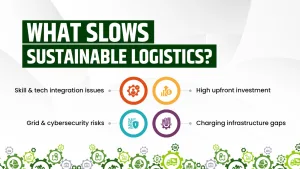
Electric vehicles, charging infrastructure, automation systems, and warehouse management software require significant upfront investment. Even though long-term savings are strong, the initial cost can deter adoption, especially for businesses with limited access to affordable finance.
Infrastructure and Connectivity Gaps
Charging infrastructure remains uneven across regions. While cities have better coverage, highways and rural areas still lack reliable charging options, limiting the use of electric vehicles for long-distance transport. Similarly, older warehouses may lack the power and connectivity needed for automation.
Technology, Skill, and Integration Barriers
Smart warehousing depends on digital systems, data analysis, and automated equipment. Many businesses face skill gaps when it comes to operating and maintaining these technologies. Integrating new systems with existing workflows can also be complex and time-consuming.
Grid Stability and Cybersecurity Risks
Large-scale EV charging and connected warehouse systems increase pressure on local power grids. At the same time, greater reliance on IoT and cloud-based platforms raises cybersecurity risks. Without proper safeguards, system failures or data breaches can disrupt operations.
Conclusion
Electric fleets and smart warehousing are changing the way logistics operates in India. Cleaner vehicles are reducing fuel dependence and operating costs, while technology-driven warehouses are improving accuracy, safety, and resource use.
Supported by strong policy initiatives and growing digital infrastructure, these changes are helping the sector move toward lower costs and better efficiency. As adoption increases, sustainable logistics will become a practical business advantage rather than a compliance requirement.
FAQs
Why Are Electric Fleets Important for Sustainable Logistics in India?
Electric fleets help reduce fuel costs, lower emissions, and improve delivery efficiency, especially in cities. With high daily usage and predictable routes, electric vehicles offer lower maintenance needs and better long-term cost control, making them suitable for last-mile and urban logistics operations.
How Do Smart Warehouses Support Sustainable Logistics?
Smart warehouses use automation, data, and connected systems to improve accuracy, reduce energy use, and minimise waste. Real-time monitoring helps control inventory losses and optimise workflows, leading to safer operations and lower environmental impact across logistics networks.
Are Electric Fleets and Smart Warehousing Only for Large Companies?
No. Service-based models such as fleet leasing, battery swapping, and shared warehouses allow smaller logistics players to access these technologies. This makes sustainable logistics achievable without large upfront investments.