


In today’s rapidly evolving global economy, the disconnect between formal education and real-world employability poses one of the most pressing challenges for nations aiming for sustainable growth. Bridging education and employability through targeted future skills development has emerged as a strategic imperative, particularly in India, where a massive youth demographic meets dynamic industry demands driven by AI, digital transformation, and sustainability.
PHD Chamber of Commerce and Industry (PHDCCI), as a premier industry body, has long championed this alignment through initiatives like its flagship World of Work program and the National Skills Summit. With India’s employability rates hovering between 42.6% and 54.81% despite producing millions of graduates annually, the need for industry-led interventions has never been more urgent. This article explores the skills gap, defines future skills, examines industry’s pivotal contributions, highlights PHDCCI’s leadership, and outlines actionable strategies to bridge the divide- empowering businesses, educators, and policymakers to co-create a Viksit Bharat by 2047.
The Widening Skills Gap: A Critical Barrier to Employability in India
India’s demographic dividend of over 600 million people under 25 represents unparalleled potential, yet persistent skills gap in India undermines this advantage. According to the India Skills Report 2025, the national employability rate stands at 54.81%, a notable improvement from 33% a decade ago but still indicating that nearly half of graduates lack the competencies employers seek. The report, based on assessments of over 6.5 lakh candidates via the Global Employability Test (GET), reveals domain-specific variations: IT graduates achieve 75% employability, Computer Science at 78%, and Engineering (B.E./B.Tech) at 71.5%, while non-technical streams like B.A. (54%) and B.Com (55%) lag significantly.
Further underscoring the crisis, Mettl’s India’s Graduate Skill Index 2025 reports an overall employability of just 42.6% in 2024, down from 44.3% in 2023. The decline is sharpest in non-technical roles such as HR and marketing, while technical domains like AI and machine learning show stronger performance at 46%. Critically, the Economic Survey 2024-25 reveals that only 8.25% of graduates secure jobs matching their qualifications, with over 50% employed in elementary or semi-skilled roles. Youth unemployment hovers around 11-13.8%, exacerbating underemployment and economic inefficiency.
Globally, the World Economic Forum’s Future of Jobs Report 2025 paints a similar picture for emerging economies like India. Employers anticipate that 39% of core skills will be disrupted or transformed by 2030, with lower-middle-income nations facing higher instability. In Southern Asia (including India), up to 94-96% of core skills are expected to evolve. Technological change, geoeconomic fragmentation, the green transition, and demographic shifts are the primary drivers, creating a mismatch where traditional curricula fail to equip students with practical, industry-relevant capabilities.
This skills gap India 2025 manifests in multiple ways: outdated pedagogical approaches emphasising rote learning over experiential application; limited integration of emerging technologies in higher education; and insufficient soft skills training in communication, critical thinking, and adaptability. The result? Employers struggle to find job-ready talent, leading to prolonged vacancies, higher training costs, and slower innovation. For businesses, this translates to lost productivity and competitive disadvantage in a market projected to see India’s tech industry reach $315 billion in FY26, heavily driven by AI.
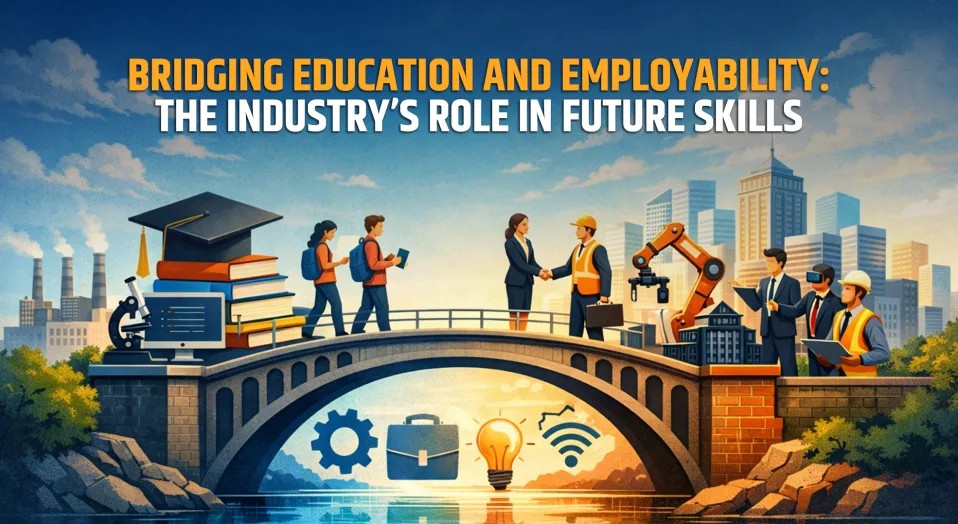
Bridging this gap requires recognizing that education alone cannot suffice. Industry’s role in future skills must involve proactive collaboration to redesign learning ecosystems. Without intervention, India risks squandering its demographic edge, even as global demand for skilled talent in AI, cybersecurity, and sustainability surges.
Defining Future Skills for the 21st Century Economy
Future skills encompass a blend of technical proficiencies, cognitive abilities, and socio-emotional competencies essential for thriving in an AI-augmented, sustainability-focused workplace. The World Economic Forum Future of Jobs Report 2025 identifies the fastest-growing skills as AI and big data, networks and cybersecurity, and technological literacy. These are complemented by enduring human strengths: creative thinking, resilience/flexibility/agility, curiosity and lifelong learning, leadership and social influence, analytical thinking, and environmental stewardship.
By 2030, workers can expect two-fifths (39%) of their skill sets to become outdated, necessitating continuous upskilling. Technological skills will dominate growth, but socio-emotional attributes like empathy, active listening, and systems thinking will differentiate high performers. In India’s context, future skills also include domain-specific expertise in green technologies, fintech, AVGC (Animation, Visual Effects, Gaming, Comics), and healthcare analytics- sectors aligned with national priorities like PLI schemes and the green transition.
NASSCOM’s FutureSkills platform exemplifies this shift, targeting reskilling/upskilling of 2 million professionals and students in nine emerging technologies, including AI, blockchain, IoT, and cybersecurity. The platform emphasizes “composite capabilities”- technical skills fused with professional acumen and domain knowledge.
For employability, soft skills remain non-negotiable. Employers rate communication, critical thinking, leadership, collaboration, and learning agility as top priorities, with 100% emphasizing ethical decision-making in tech contexts. In the India Skills Report 2025, companies highlight adaptability/problem-solving (85% very/extremely important) and digital literacy/data fluency as critical.
Future skills are not static; they demand lifelong learning models. Micro-credentials, modular certifications, virtual internships (over 2 lakh facilitated by AICTE), and apprenticeships under NAPS/PMKVY provide pathways. Industry must lead by defining these competencies through advisory boards, co-designing curricula, and offering immersive experiences like hackathons, live projects, and mentorship programs.
Challenges in Aligning Education with Industry Needs
Despite progressive policies like the National Education Policy (NEP) 2020, which promotes multidisciplinary education, multiple entry/exit options, and industry integration, implementation hurdles persist. Rigid curricula, faculty skill deficits, and inadequate infrastructure limit experiential learning. Many institutions remain supply-driven rather than demand-oriented, producing graduates mismatched with Industry 4.0 requirements.
Geographic disparities compound the issue: Tier-1 cities like Pune (78.32% employability) and Bengaluru (76.48%) outperform others, while rural and smaller states lag due to limited industry exposure. Gender gaps are evident- female employability at 46.53% trails males (53.47%) necessitating targeted interventions in STEM and caregiving sectors.
Regulatory fragmentation, funding constraints, and slow adoption of technology in assessment further widen the chasm. The Economic Survey notes 88.2% of the workforce in low-competency jobs, highlighting systemic under-skilling. Without robust industry-academia collaboration, NEP 2020’s vision of flexible, skill-centric education risks remaining aspirational.
The Industry’s Pivotal Role in Shaping Future-Ready Talent
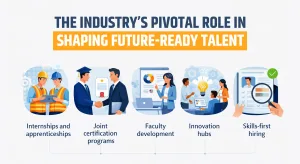
Industry is uniquely positioned to bridge education and employability by acting as co-creator, trainer, and certifier of talent. Leading organizations invest in reskilling (72% for AI per WEF), apprenticeships, and curriculum co-design. NASSCOM’s FutureSkills platform and CII’s multi-skill institutes demonstrate scalable models, training lakhs annually with measurable placement outcomes.
Companies gain through reduced hiring costs, higher retention, and innovation velocity. Strategies include:
- Internships and apprenticeships: Mandatory industry exposure via NEP-mandated credits.
- Joint certification programs: Micro-credentials in AI, cybersecurity validated by employers.
- Faculty development: Industry experts as adjunct professors or trainers.
- Innovation hubs: On-campus centers for R&D co-funded by corporates.
- Skills-first hiring: Removing degree barriers (30% of Indian firms per WEF) to tap diverse talent (67% plan this, vs. 47% global average).
In sunrise sectors like renewable energy, AVGC, and healthcare, industry-led labs (e.g., proposed AVGC Content Creator Labs in 15,000 schools) accelerate readiness. Public-private partnerships under Skill India, PMKVY, and SAMARTH 2.0 amplify impact, targeting 1 lakh allied health professionals and caregivers.
The ROI is clear: reskilled workforces boost productivity (77% of employers report gains) and competitiveness. For MSMEs, which form India’s economic backbone, targeted programs in digital marketing, automation, and entrepreneurship are transformative.
PHDCCI’s Leadership in Bridging the Divide
PHDCCI exemplifies industry’s proactive role through its sustained World of Work initiative, which advances skill development across States and Union Territories. As affirmed by Dr. Jitendra Singh, Hon’ble Minister of State (Independent Charge), Ministry of Science & Technology, “PHDCCI has played a sustained and focused role through its ‘World of Work’ initiative in advancing skill development across States and Union Territories.”
The National Skills Summit 2026, themed ‘Skilled Bharat for Viksit Bharat@2047’, convened policymakers, industry leaders, academia, and Sector Skill Councils to deliberate on emerging job roles, inclusive strategies, and global partnerships. Key highlights included Siemens’ “Pathway to Learning Engineering” for bridging classroom-to-industry gaps in advanced manufacturing, and panels on AI ethics, green jobs, and women’s workforce participation.
In its Union Budget 2026-27 recommendations, PHDCCI proposed an Education-to-Employment and Enterprise Standing Committee for curriculum alignment and AI impact assessment. Other suggestions include AVGC labs, SAMARTH 2.0 for textiles, University Townships near industrial corridors, and Centres of Excellence in AI (₹500 crore outlay). These align education with job markets, targeting 10% global services share by 2047.
PHDCCI’s MSME Facilitation Centres, Entrepreneurship Skill Development Programmes (ESDP), and collaborations with NIESBUD, NSDC, and global partners like ILO further strengthen the ecosystem. By facilitating CSR-supported skill centres and transparent industry linkages, PHDCCI drives inclusive growth for youth, women, and disadvantaged communities.

Strategic Roadmap: Recommendations for Stakeholders
To accelerate progress:
- Establish mandatory industry representation on university boards (per NEP).
- Scale apprenticeship incentives under NAPS with tax benefits.
- Launch national micro-credential framework for future skills.
- Incentivize corporate investment in skill infrastructure via CSR and Viability Gap Funding.
- Promote gender-inclusive skilling in STEM and green sectors.
- Leverage AI for personalized learning and gap analysis.
PHDCCI urges businesses to join its World of Work ecosystem, co-host summits, and adopt skills-first hiring.
Conclusion: A Call to Collaborative Action
Bridging education and employability demands urgent, collective action where industry leads future skills development. With employability at 54.81% (India Skills Report 2025) and 39% skills disruption looming (WEF 2025), the window for transformation is narrow yet filled with opportunity.
PHDCCI stands ready as a catalyst through World of Work, National Skills Summits, and policy advocacy to forge resilient talent pipelines. Businesses, academia, and government must partner relentlessly: co-create curricula, invest in reskilling, and measure success by placement quality and innovation output.