






Indian agriculture is going through a major shift. For decades, the focus was on producing enough food for the domestic population. Today, the priority is changing toward improving farmer incomes, reducing losses after harvest, and connecting farms to global markets. Agriculture still employs more than 45% of India’s workforce, yet a large share of value is lost due to weak storage, processing, and logistics systems.
India is already a leading producer of milk, pulses, spices, fruits, and marine products. At the same time, exports remain uneven and vulnerable to policy changes, infrastructure gaps, and global regulations. Post-harvest losses alone are estimated at ₹92,000+ crore every year. This article explains how India’s agri-value chain works today, where it falls short, and what needs to improve to move farm produce smoothly from local fields to global consumers.
What Is an Agri-Value Chain?
An agri-value chain covers every step that moves agricultural produce from the farm to the final buyer. This includes input supply, farming, storage, processing, transport, marketing, and export. The goal is not just higher production, but better value through reduced wastage, processing, quality control, and market access, so farmers earn more from the same produce.
India’s Shift From Production to Value-Led Agriculture
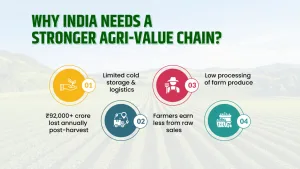
India’s agricultural strategy is changing to meet new income and market realities. The focus is moving away from producing large volumes of a few crops toward improving value, quality, and market reach. This shift is necessary to stabilise farmer incomes and reduce dependence on domestic price support.
From Food Security to Income Security
For many years, policies centred on wheat and rice through minimum support prices and public procurement. While this ensured food availability, it limited diversification. As consumption patterns changed and high-value crops gained demand, income security became a larger concern than volume alone.
Export Growth and Policy Volatility
Agricultural exports have shown resilience, but they remain sensitive to domestic policy changes. For example, while basmati rice exports stayed strong, non-basmati rice exports dropped sharply following export restrictions. Such volatility affects India’s reliability as a global supplier.
Export Landscape: Commodities and Markets
India’s agri-exports are spread across traditional and emerging markets. While proximity plays a major role for perishables, processed and industrial-use products travel farther. The export pattern shows both opportunity and risk, especially when dependence on a few countries becomes high.
| Commodity Category | Top Destination | Share (%) | Second Destination | Share (%) | Key Insight |
| Floriculture | Iraq | 31.65 | United Kingdom | 15.75 | Middle East demand driven by cultural use; UK demand linked to retail and diaspora |
| Groundnuts | Indonesia | 35.10 | Vietnam | 30.26 | Southeast Asia acts as a major processing hub |
| Guar Gum | United States | 18.17 | Germany | 18.06 | Industrial demand drives exports |
| Fresh Vegetables | UAE | 15.12 | Nepal | 7.19 | Proximity is critical due to limited cold chain |
| Buffalo Meat | Vietnam | — | Egypt | — | Vietnam serves as a redistribution hub in Asia |
Policy Support Strengthening the Agri-Value Chain
Government policy plays a central role in fixing gaps across India’s agri-value chain. Over the past few years, targeted schemes have focused on post-harvest infrastructure, food processing, and cluster-based development to help farmers and agri-businesses move closer to markets and improve value realisation.
Agriculture Infrastructure Fund (AIF)
The Agriculture Infrastructure Fund was created to address post-harvest losses and weak farm-gate infrastructure.
It provides medium to long-term loans with interest support for building assets such as warehouses, pack-houses, grading units, cold storage, and primary processing facilities.
A key strength of AIF is its focus on community assets, allowing FPOs, cooperatives, and SHGs to create shared infrastructure that individual farmers cannot afford on their own.
Production Linked Incentive (PLI) for Food Processing
The PLI scheme targets the processing layer of the agri-value chain. It encourages investment in high-value food products such as ready-to-eat, ready-to-cook, dairy-based products, marine processing, and specialty foods.
By supporting large-scale processing and branding, the scheme creates steady demand for raw agricultural produce and helps reduce farmers’ exposure to price volatility in fresh markets.
One District One Product (ODOP)
ODOP recognises that agricultural strengths vary by region. Instead of applying a uniform approach, the scheme identifies one key product per district and focuses support on developing its full value chain.
This includes processing facilities, branding, skill development, and market access. The cluster-based approach helps improve efficiency, encourages local specialisation, and supports region-specific income growth.
Farmer-Producer Organisations (FPOs) as Value Chain Anchors
Small and fragmented landholdings make it difficult for individual farmers to access large markets or exporters directly. Farmer Producer Organizations (FPOs) address this gap by bringing farmers together, allowing them to operate at scale and participate more effectively in value chains.
Why Aggregation Is Critical for Farmers?
Most farmers cultivate small plots, which limits bargaining power and market reach. FPOs aggregate produce from many members, creating volumes large enough to attract buyers, processors, and exporters. This aggregation helps farmers move beyond local traders and access better price discovery.
Input Aggregation and Cost Reduction
FPOs also support farmers before production begins. By purchasing seeds, fertilisers, and other inputs in bulk, they reduce per-unit costs for members. Collective buying improves input quality, lowers dependency on informal credit, and improves farm-level productivity.
Output Aggregation and Market Access
On the selling side, FPOs collect, grade, and sort produce to meet buyer requirements. Larger volumes allow them to negotiate better prices and enter formal markets such as exporters, retail chains, and processors. This reduces reliance on intermediaries and improves farmer incomes.
Challenges in Management and Working Capital
While FPOs offer strong benefits, many face operational challenges. Limited professional management, lack of marketing expertise, and shortage of working capital restrict growth. Without timely finance and skilled leadership, some FPOs struggle to move beyond basic aggregation into processing or branding.
Role of Policy Support for FPO Growth
Government programs supporting equity grants, credit guarantees, and infrastructure have helped expand the FPO network. However, long-term success depends on building managerial capacity, improving access to finance, and integrating FPOs more deeply into processing and export-oriented value chains.
Technology and Traceability in Agri-Exports
As India targets high-value global markets, technology and traceability have become essential parts of the agri-value chain. Buyers now expect clear proof of origin, safety, and compliance. Digital systems help build this trust while reducing rejection risks and improving market access.
Digital Traceability Systems for Exports
Traceability systems track produce from the farm to the export destination. They record details such as farm location, input use, harvest date, and testing results. This information helps exporters meet food safety rules and respond quickly if issues arise. Strong traceability also improves buyer confidence and repeat orders.
Blockchain-Based Traceability Models
Blockchain adds an extra layer of trust by making data tamper-proof. Once information is entered, it cannot be changed without leaving a record. This is especially useful for exports to strict markets, where buyers want assurance that test results and farm data are reliable. Blockchain-based systems reduce disputes and improve transparency across the chain.
Strategic Roadmap to Strengthen India’s Agri-Value Chain
Strengthening India’s agri-value chain requires focused action across infrastructure, institutions, technology, and compliance. The goal is to reduce losses, improve value realisation, and help farmers and agri-businesses compete in global markets in a stable and predictable way.
Build Village-Level Pack-House and Pre-Cooling Networks
Post-harvest losses start immediately after harvest. Setting up pack-houses close to farms allows grading, sorting, and pre-cooling within hours. These facilities improve shelf life and export quality. Priority should shift from large, central cold stores to smaller, local units that serve clusters of farmers and FPOs.
Upgrade FPOs From Aggregation to Processing
Most FPOs currently focus only on collection and sale. To capture more value, they need support to enter processing, storage, and branding. This includes access to working capital, technical guidance, and market linkages. Processing helps protect farmers from price crashes and reduces dependence on fresh markets.
Strengthen Bio-Security and Farm-Level Practices
Export rejections often happen due to residue and quality issues that start at the farm. Regular farmer training on input use, disease control, and harvest practices is essential. Testing should happen at the farm or pack-house level, not only at ports, to prevent last-minute losses and reputation damage.
Improve Logistics and Promote Green Transport
High logistics costs reduce export competitiveness. Expanding rail-based and sea-based transport for perishables can lower costs and emissions. Better first-mile connectivity to railheads and ports is critical. Over time, efficient logistics will also reduce exposure to future carbon-linked trade measures.
Align Digital Systems With Global Compliance Needs
Global markets are demanding proof of origin, land use, and sustainability. A unified digital system that links farmer records, land data, and traceability platforms will help meet these requirements. This alignment is key to handling future regulations related to deforestation, carbon footprint, and food safety.
This roadmap focuses on practical improvements that connect farms to markets more efficiently, reduce risk, and improve income stability across India’s agri-value chain.
Conclusion
India’s journey from farm to global market depends on how well its agri-value chain handles value addition, infrastructure, and compliance. Strong storage, efficient logistics, empowered FPOs, and reliable traceability systems are no longer optional. They determine whether Indian produce can compete consistently in global markets.
With focused policy support and practical execution on the ground, India can reduce losses, stabilise farmer incomes, and move from exporting raw produce to delivering trusted, high-value agricultural products worldwide.
FAQs
Why Does India Lose Value Despite Being a Major Agricultural Producer?
India produces large volumes of crops, but weak storage, limited processing, and high logistics costs reduce value after harvest. Much of the produce is sold in raw form, which is sensitive to price swings and spoilage. Without strong value addition and market integration, higher production does not always translate into higher farmer income.
How Do FPOs Help Farmers Access Global Markets?
FPOs bring farmers together to create scale. By aggregating produce, they meet volume and quality requirements of exporters and large buyers. FPOs also support better input sourcing, basic processing, and compliance with buyer standards, which individual farmers usually cannot manage on their own.
Why Is Cold Chain Infrastructure So Important for Agri-Exports?
Cold chain infrastructure protects quality after harvest. Without pre-cooling, grading, and temperature-controlled storage, perishable produce loses freshness quickly. This reduces shelf life, increases rejection risk, and limits access to distant or high-value markets, especially for fruits, vegetables, and floriculture products.
How Do Global Regulations Affect Indian Agricultural Exports?
Global markets increasingly require proof of food safety, traceability, and sustainable production. Regulations related to land use, carbon footprint, and residue limits raise compliance costs. Small farmers and exporters must adapt systems and practices to meet these rules, or risk losing access to key export destinations.
Can Small Farmers Benefit From Export-Oriented Agri-Value Chains?
Yes, but not individually. Small farmers benefit when they are part of organised systems such as FPOs or clusters. Aggregation, shared infrastructure, and collective compliance reduce costs and risks, allowing small producers to participate in export markets without bearing the full burden alone.