






Agriculture in India continues to face deep structural challenges. Problems like low farm incomes, uneven productivity, climate stress, and limited access to markets continue to dwell. While government schemes have improved coverage, public resources alone are not enough to solve these issues at scale. At the same time, private innovation often struggles to reach small and marginal farmers due to high risk and fragmented demand.
Public-private collaboration in AgriTech brings these two sides together. Government support in policy, infrastructure, and data, combined with private investment, technology, and market access. This partnership is helping farmers improve yields, reduce costs, and access better prices. The article explains how such collaborations work, where they create the most impact, and how they are boosting rural income and productivity.
What Is Public-Private Collaboration in AgriTech?
Public-private collaboration in AgriTech is a long-term partnership where government bodies and private companies work together to improve farming outcomes. The public side provides policy support, data systems, and infrastructure, while private players bring technology, investment, and market linkages. Both share risks and responsibilities to improve productivity, income, and sustainability in agriculture.
Why Indian Agriculture Needs Public-Private Collaboration?
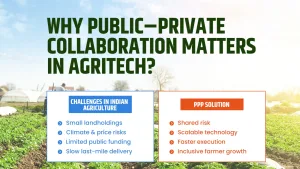
Indian agriculture faces multiple challenges that cannot be solved by one side alone. Public-private collaboration helps combine policy support with practical solutions, making progress faster and more effective.
Structural Issues in Farming Systems
Most farmers work on small landholdings and depend on traditional methods. This limits productivity and makes it hard to absorb climate shocks. Public support alone cannot modernise millions of farms at the same time, while private solutions often remain out of reach without support.
Limits of Public Funding and Execution
Government programs aim to support farmers, but budget limits, slow rollout, and last-mile delivery gaps reduce their impact. Large investments in technology, storage, and logistics need additional capital and operational efficiency that the public sector cannot always provide on its own.
Barriers for Private Investment Alone
Private companies bring innovation and speed, but agriculture carries high risks due to weather, price swings, and long return periods. Without risk-sharing, incentives, and policy clarity, private players hesitate to invest deeply in rural and smallholder-focused solutions.
Need for Scalable and Inclusive Growth
Public-private collaboration allows shared risk, better resource use, and wider reach. It helps ensure that technology, finance, and market access reach small and marginal farmers, not just large or well-connected producers.
Core Roles of Public and Private Stakeholders in AgriTech PPPs
Public-private partnerships in AgriTech work best when each stakeholder focuses on what they do best. Clear role division helps avoid overlap, improves execution, and ensures that farmers receive practical benefits on the ground.
Role of the Public Sector
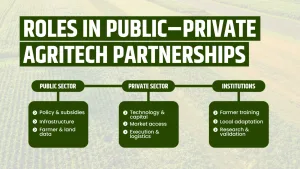
The public sector sets the foundation for AgriTech collaboration. It creates policies, provides subsidies, and invests in core infrastructure such as roads, irrigation, storage, and digital connectivity. Government bodies also manage farmer databases, land records, and market platforms, which help scale AgriTech solutions across regions.
Role of the Private Sector
Private players bring innovation, capital, and execution strength. They develop technologies like precision farming tools, advisory apps, drones, and supply chain platforms. Private firms also build efficient logistics, connect farmers to markets, and invest in scalable business models that improve productivity and income.
Role of Research and Knowledge Institutions
Research institutions support AgriTech PPPs by developing crop solutions, testing new practices, and adapting technology to local conditions. They help train farmers, validate tools, and ensure that innovations remain practical, affordable, and suitable for different agro-climatic zones.
Key Areas Where AgriTech PPPs Create Impact
Public-private collaboration in AgriTech delivers results when it focuses on areas that directly affect farm productivity, income, and efficiency. These partnerships combine policy support with technology and execution to solve long-standing gaps in the agricultural value chain.
Technology and Innovation Adoption
AgriTech PPPs help farmers access modern tools such as precision farming solutions, AI-based advisory systems, IoT sensors, and drones. Government-backed data and subsidies lower adoption barriers, while private players ensure that technology is practical and scalable. This improves decision-making related to sowing, irrigation, pest control, and harvesting.
Infrastructure Development
Infrastructure remains a major constraint in agriculture. PPPs support the development of cold storage, warehouses, grading units, and logistics networks. Public funding and policy support reduce risk, while private operators manage assets efficiently. Better infrastructure cuts post-harvest losses and improves supply chain reliability.
Market Access and Price Realisation
AgriTech PPPs strengthen market linkages by connecting farmers directly to buyers. Digital platforms, price discovery tools, and structured buy-back arrangements reduce dependence on intermediaries. This ensures better price transparency, faster payments, and more stable incomes for farmers.
Major Government Schemes Enabling AgriTech Collaboration
Government-led schemes play a key role in attracting private participation and scaling AgriTech solutions. These programs reduce risk, improve access to finance, and create digital and physical infrastructure that private players can build upon.
Digital Agriculture Mission and AgriStack
The Digital Agriculture Mission focuses on creating a unified digital ecosystem for farming. AgriStack provides verified farmer data, land records, and crop information. Private AgriTech companies use this data to deliver localised advisories, pest alerts, and input recommendations, helping farmers reduce costs and improve yields.
Agriculture Infrastructure Fund (AIF)
The Agriculture Infrastructure Fund supports investment in storage, warehousing, cold chains, and processing units. Through interest subvention and credit support, it encourages banks and private firms to co-invest in rural infrastructure. This reduces post-harvest losses and improves farmers’ ability to sell produce at better prices.
Drone and Shared Equipment Initiatives
Schemes promoting drones and custom hiring centres enable farmers to access expensive technology without ownership. Private firms provide services such as precision spraying and mapping, while government support helps with training and deployment. These models improve efficiency and create new rural service-based income opportunities.
Shared Technology Models Improving Productivity
Shared technology models allow farmers to use modern tools without bearing high ownership costs. These models work well in public-private partnerships because they combine government support with private execution, making advanced technology affordable and accessible.
Equipment-as-a-Service Models
Under this model, farmers rent machinery such as tractors, harvesters, and sprayers for a few hours or days. Private AgriTech firms operate custom hiring centres, while government schemes support infrastructure and outreach. This reduces capital burden and helps small farmers use modern equipment during critical farm operations.
Data-Driven Advisory Services
Shared digital platforms provide crop advisory, weather alerts, and pest warnings using government data and private analytics. Farmers receive timely guidance through mobile apps or local centres. This improves input use, reduces crop loss, and supports better yield planning.
Shared Irrigation and Resource Tools
Public-private efforts also support shared irrigation systems, soil testing services, and nutrient management tools. Farmers pay only for usage, while private operators maintain systems. These tools improve water efficiency, soil health, and long-term productivity.
Impact of Public-Private AgriTech Collaboration on Rural Income
Public-private collaboration in AgriTech directly influences how much farmers earn and how stable their income remains. By improving productivity, reducing losses, and strengthening market access, these partnerships address income challenges at multiple stages of farming.
Higher Yields and Lower Production Costs
Access to precision tools, quality inputs, and timely advisory helps farmers make better decisions. Optimised use of seeds, fertilisers, water, and pesticides improves yields while cutting unnecessary expenses. Over time, this balance of higher output and controlled costs leads to better net income.
Improved Price Realisation and Market Stability
Digital platforms and structured market linkages reduce dependence on middlemen. Farmers gain access to real-time prices, organised buyers, and assured procurement models. This improves bargaining power and protects income from sudden price drops.
New Rural Income Opportunities
AgriTech PPPs create service-based jobs in rural areas. Equipment rental, drone operations, data collection, and logistics generate additional income streams beyond farming. These opportunities support livelihood diversification and reduce income pressure during low-yield seasons.
ESG Outcomes of AgriTech Public-Private Partnerships
AgriTech public-private partnerships deliver results beyond productivity and income. They also strengthen environmental protection, social well-being, and governance practices across rural ecosystems. These outcomes help make agriculture more resilient and responsible over the long term.
Environmental Sustainability
AgriTech PPPs promote efficient use of natural resources. Precision farming tools reduce excess use of water, fertilisers, and pesticides. Shared irrigation systems and data-based advisory limit soil damage and conserve water. Over time, these practices lower emissions, reduce pollution, and support climate-resilient farming.
Social Impact on Farmers and Rural Communities
These partnerships improve livelihoods by increasing income stability and reducing risk. Better access to information, markets, and financial services empowers farmers to make informed decisions. Training programs and shared service models also create local jobs, especially for youth and women, strengthening rural economies.
Governance and Transparency
Digital platforms and structured partnerships improve accountability. Clear data trails, standard processes, and monitored implementation reduce misuse of resources. Transparent pricing, traceability, and compliance frameworks build trust among farmers, private players, and government agencies.
What Makes AgriTech PPPs Sustainable in the Long Term?
For public-private partnerships in AgriTech to deliver lasting impact, they must be designed for continuity, inclusion, and trust. Long-term sustainability depends on how well these collaborations balance commercial goals with farmer welfare.
Clear Risk-Sharing Mechanisms
Successful PPPs clearly define how financial, operational, and market risks are shared. Government support reduces exposure to climate and price shocks, while private players manage technology and execution risks. This balance encourages long-term investment.
Farmer-Centric Design
Solutions must suit small and marginal farmers. Simple interfaces, affordable pricing, and local language support increase adoption. When tools solve real problems on the ground, farmers remain engaged beyond pilot phases.
Continuous Capacity Building
Ongoing training and support ensure that farmers can use technology effectively. Feedback loops between farmers, private firms, and public agencies help refine solutions and adapt them to changing conditions.
Conclusion
Public-private collaboration in AgriTech has emerged as a practical way to address long-standing challenges in Indian agriculture. By combining government support with private innovation, these partnerships improve productivity, strengthen market access, and raise rural incomes.
When designed with clear roles, shared risk, and a strong focus on farmers’ needs, AgriTech PPPs create lasting value. Their success lies in scaling technology responsibly, building local capacity, and ensuring that growth remains inclusive, resilient, and sustainable over time.
FAQs
Are AgriTech PPPs Only Useful For Large Or Commercial Farms?
No. Many AgriTech PPP models are designed for small and marginal farmers. Shared equipment services, digital advisory, and group-based access models ensure that benefits reach farmers with limited land, capital, and resources across rural areas.
What Role Do Digital Platforms Play In AgriTech Collaboration?
Digital platforms connect farmers with data, buyers, service providers, and financial support. They improve price transparency, enable timely advisory, and reduce reliance on intermediaries. These platforms also help governments and private players monitor impact and improve service delivery.
How Do AgriTech PPPs Reduce Farming Risks?
AgriTech PPPs use data and technology to manage uncertainty. Weather alerts, pest warnings, crop insurance, and buy-back arrangements help farmers plan better and protect income. Shared risk between public and private partners reduces exposure to losses from climate and market shocks.