


In the shifting landscape of the global economy, the narrative of “Women in Industry Leadership” has transitioned from a matter of social equity to a critical business imperative. As India marches toward its vision of Viksit Bharat by 2047, the integration of women into high-stakes decision-making roles is no longer optional- it is the engine of sustainable growth.
This comprehensive analysis explores the current state of women in Indian industry leadership as of 2026, identifying the structural gaps that persist and the robust policy frameworks designed to bridge them.
The Landscape of Progress: India’s 2026 Trajectory
The year 2026 serves as a pivotal milestone for corporate India. According to recent strategic projections, Indian companies are moving beyond “tokenism” toward a “critical mass” of female representation.
Key Statistics and Milestones
- Boardroom Composition: Nifty 500 companies are projected to exceed 25% female representation in boardrooms by the end of 2026, up from approximately 18-19% in 2024.
- Gender Budgeting: The Union Budget 2026-27 has increased the share of the Gender Budget to 9.37% of the total Union Budget, with an allocation of ₹5.00 lakh crore for women’s welfare- an 11.36% increase from the previous fiscal year.
- Global Standing: While India slipped to 131st in the Global Gender Gap Index 2025 (WEF), there is significant momentum in Economic Participation and Political Empowerment, which are the primary drivers of parity scores in the current year.
Identifying the Gaps: The “Broken Rung” and Cultural Barriers
Despite the legislative and financial push, structural friction remains. A 2026 progress report on women in the workplace highlights a “perception-progress gap.”
The Glass Ceiling vs. The Broken Rung
While much focus is placed on the “Glass Ceiling” (the barrier to top executive roles), the “Broken Rung” at the entry-level and mid-management levels is where the pipeline leaks most.
- Leadership Underrepresentation: Approximately 57% of professionals still believe women are underrepresented in leadership within their organizations.
- Cultural Dominance: Nearly 49% of survey respondents identify company culture as the primary barrier to progression, far outweighing pay disparity or lack of advocates.
- The Broken Pipeline: Globally, women hold only 28.8% of top leadership positions despite representing 41.2% of the workforce.
Sectoral Disparity
While the IT and Banking sectors have historically led in gender diversity, heavy industries like Manufacturing and Infrastructure are seeing the largest growth in female board representation in 2026, signaling a shift in traditionally male-dominated verticals.
Policy Support: Government and Institutional Catalysts
The Indian government has transitioned from “women’s development” to “women-led development.” This shift is backed by a multi-layered policy framework.
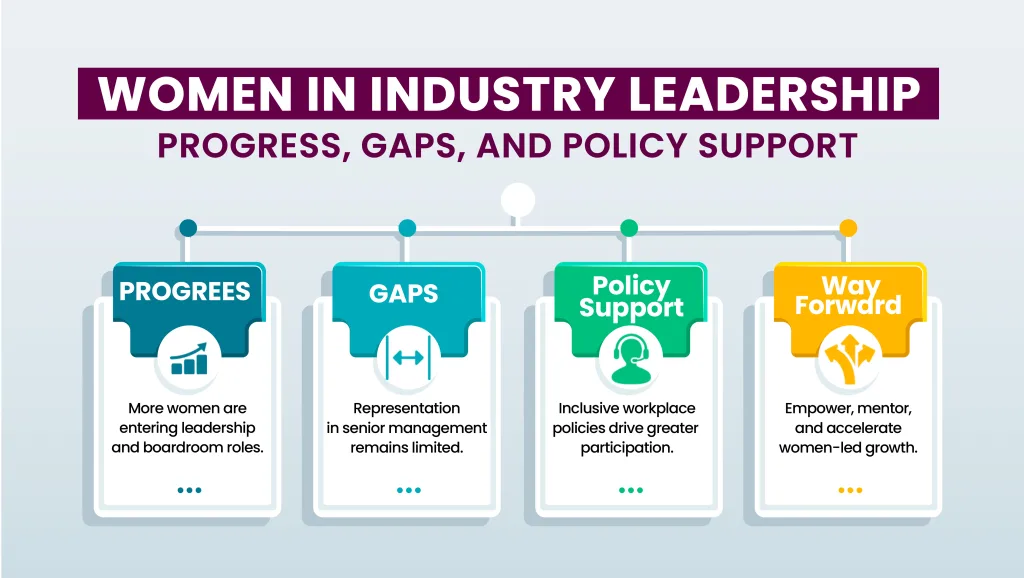
Women in Industry Leadership: Progress, Gaps, and Policy Support
In the shifting landscape of the global economy, the narrative of “Women in Industry Leadership” has transitioned from a matter of social equity to a critical business imperative. As India marches toward its vision of Viksit Bharat by 2047, the integration of women into high-stakes decision-making roles is no longer optional- it is the engine of sustainable growth.
This comprehensive analysis explores the current state of women in Indian industry leadership as of 2026, identifying the structural gaps that persist and the robust policy frameworks designed to bridge them.
-
The Landscape of Progress: India’s 2026 Trajectory
The year 2026 serves as a pivotal milestone for corporate India. According to recent strategic projections, Indian companies are moving beyond “tokenism” toward a “critical mass” of female representation.
Key Statistics and Milestones
- Boardroom Composition: Nifty 500 companies are projected to exceed 25% female representation in boardrooms by the end of 2026, up from approximately 18-19% in 2024.
- Gender Budgeting: The Union Budget 2026–27 has increased the share of the Gender Budget to 9.37% of the total Union Budget, with an allocation of ₹5.00 lakh crore for women’s welfare- an 11.36% increase from the previous fiscal year.
- Global Standing: While India slipped to 131st in the Global Gender Gap Index 2025 (WEF), there is significant momentum in Economic Participation and Political Empowerment, which are the primary drivers of parity scores in the current year.
-
Identifying the Gaps: The “Broken Rung” and Cultural Barriers
Despite the legislative and financial push, structural friction remains. A 2026 progress report on women in the workplace highlights a “perception-progress gap.”
The Glass Ceiling vs. The Broken Rung
While much focus is placed on the “Glass Ceiling” (the barrier to top executive roles), the “Broken Rung” at the entry-level and mid-management levels is where the pipeline leaks most.
- Leadership Underrepresentation: Approximately 57% of professionals still believe women are underrepresented in leadership within their organizations.
- Cultural Dominance: Nearly 49% of survey respondents identify company culture as the primary barrier to progression, far outweighing pay disparity or lack of advocates.
- The Broken Pipeline: Globally, women hold only 28.8% of top leadership positions despite representing 41.2% of the workforce.
Sectoral Disparity
While the IT and Banking sectors have historically led in gender diversity, heavy industries like Manufacturing and Infrastructure are seeing the largest growth in female board representation in 2026, signaling a shift in traditionally male-dominated verticals.
Policy Support: Government and Institutional Catalysts
The Indian government has transitioned from “women’s development” to “women-led development.” This shift is backed by a multi-layered policy framework.
National Initiatives
- Mission Shakti: A flagship umbrella scheme with two sub-components:
- Sambal: Focused on safety and security (One Stop Centres, 181 Helpline).
- Samarthya: Focused on economic empowerment (Pradhan Mantri Matru Vandana Yojana, Creche facilities).
- Lakhpati Didi & SHGs: Strengthening the rural leadership pipeline by empowering 3 crore women through Self-Help Groups (SHGs) to become micro-entrepreneurs.
- STEM Incentives: Targeted scholarships and infrastructure improvements have led to female enrollment in higher education surpassing male enrollment in specific technical domains.
The Role of PHDCCI: Driving Inclusion in the MSME and Industrial Sector
The PHD Chamber of Commerce and Industry (PHDCCI), a 121-year-old apex chamber, plays a monumental role in translating policy into industrial practice.
Key PHDCCI Initiatives in 2026
Through its Women, Child Development & Entrepreneurship Committee, PHDCCI is actively dismantling barriers for women leaders:
- Her Enterprise (हर दिन): A flagship workshop series launched in early 2026 focusing on Financial Awareness. It addresses the hesitation among women entrepreneurs to scale by providing training on cash flow management, regulatory compliance, and MUDRA loan access.
- WE POWER Platform: A collaborative ecosystem introduced by PHDCCI to foster “generational leadership.” It provides a networking hub where established women leaders mentor budding entrepreneurs.
- Skill Development: The PHD Family Welfare Foundation manages 35 skill development centres across India, having already empowered over 70,000 women to achieve economic self-reliance.
- Recognition and Advocacy: Annual felicitations of women leaders in STEM, Business, and Social Impact (such as the March 2026 awards) serve to build high-visibility role models for the next generation.
Strategic Recommendations for 2026 and Beyond
To close the leadership gap by 2030, Indian industries must transition from a passive stance to a “Sprint” mentality, focusing on four critical strategic pillars:
First, Pipeline Development requires the immediate implementation of “diverse slate” policies. This ensures that 50% of all shortlists for senior-level roles consist of qualified women, effectively widening the talent pool and preventing systemic bias at the recruitment stage.
Second, there must be a significant Policy Evolution regarding board composition. Companies should move beyond appointing “Compliance Directors”- who may be added simply to meet regulatory quotas and prioritize the appointment of “Independent Professional Directors.” These leaders must be granted substantive decision-making power and strategic influence to impact the company’s bottom line.
Third, Flexibility has emerged as the most critical retention tool. With 67% of professionals citing flexible work arrangements as the most impactful policy for their career longevity, organizations must move away from ad-hoc permissions and instead institutionalize flexible work models as a core corporate standard.
Finally, Transparency is essential to ensure long-term equity. Indian firms should aim to adopt comprehensive pay transparency metrics by the end of 2026. By publicly or internally reporting on compensation structures, organizations can actively identify and eliminate the boardroom pay gap, fostering a culture of trust and meritocracy.
Conclusion: The Roadmap to 2047
The journey of women in industry leadership in India is at a crossroads. While policy support from the government and proactive advocacy by institutions like PHDCCI have laid a strong foundation, the responsibility now lies with corporate leadership to fix the “Broken Rung.”
As we look toward 2047, the goal is not just to reach a percentage but to create an ecosystem where leadership is gender-agnostic. The question for Indian industry is no longer “Why women?” but “How fast can we integrate them?”