






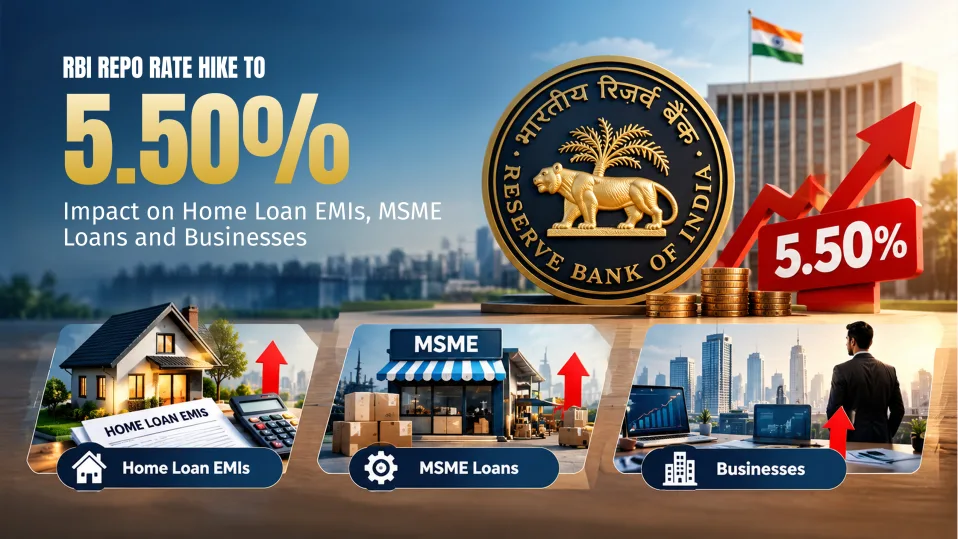
The Reserve Bank of India raised the policy repo rate by 25 basis points to 5.50% on 7 October 2026, with the RBI Monetary Policy Committee (MPC) voting unanimously in favor of the hike. Marking its first-rate increase since February 2023, the MPC also shifted its stance from “neutral to calibrated tightening.”
The October 2026 announcement highlights diverging macro indicators: The central bank revised its FY2027 growth forecast upwards to 7.1% while raising its inflation projection to 5.2%. Resilient growth momentum provided the MPC the leeway to act, while persistent inflation pressures supplied the imperative to increase repo rate.
For borrowers, the immediate fallout is costlier floating-rate credit, though the speed and magnitude of the impact depend on which of India’s two active lending rate regimes governs their loan. Currently, both the External Benchmark Lending Rate (EBLR/ECLR) and the Marginal Cost of Funds-based Lending Rate (MCLR) are simultaneously in action across the banking system, serving distinct borrower segments and structural purposes. Home loan EMIs linked to EBLR/ECLR will rise swiftly at the next quarterly reset date, whereas legacy retail loans and large corporate facilities anchored to MCLR will experience a more buffered, cost-of-funds-driven adjustment. Financing of working capital especially for MSME will become costly, and capital-intensive industries must recalibrate their capex timelines.
This article examines the transmission across each channel, takes into account the dual EBLR/ECLR and MCLR architecture and outlines the PHD Chamber of Commerce and Industry (PHDCCI) mitigation playbook.
Understanding the Macroeconomic Backdrop Behind the 25-bps Shift to 5.50%
The October 2026 hike reintroduces a tightening bias after a prolonged period of monetary accommodation. Market participants tracking the RBI’s rate cycle will recall the aggressive 2022–2023 tightening phase, when the repo rate hike from 4.00% to 6.50% to tame post-pandemic price pressures. After holding rates steady at 6.50% through late 2024, the MPC commenced an easing cycle in 2025 that brought the policy rate down to 5.25%.
While this lower rate regime supported robust credit growth through early 2026, the August pause and neutral stance proved temporary. The October rate increase officially ends an easing and holds a hiatus of more than three and a half years since the last hike in February 2023.
Why did the MPC act now? The reason behind the decision centers on three compounding macro factors:
- Persistent Inflation: The RBI raised its FY2027 CPI projection to 5.2%, which signals that price pressures are proving more persistent than earlier forecasts suggested. Central banks cannot wait for supply-side relief when prices refuse to cool.
- Import Price Volatility: Global commodity volatility adds a second pressure. Energy, metals and edible oil prices feed quickly into Indian input costs. India imports a large share of its crude requirement, so any sustained spike widens the import bill and weakens the rupee.
- Currency & Yield Differentials: Currency stabilisation, therefore, forms the third driver. Widening interest rate differentials, against advanced market central banks, risk stoking capital outflows and currency volatility. A rate adjustment reinforces external stability and supports the rupee.
Together, these forces explain why the MPC preferred a modest 25 bps increase. The move has allowed RBI to anchor inflation expectations early rather than risking steeper, reactive hikes down the line.
Strong domestic fundamentals gave the central bank the requisite cushion to act: the RBI revised its FY2027 GDP forecast from 6.7% to 7.1%, confident that resilient domestic demand can readily absorb incremental borrowing costs.
While the rate hike itself was passed unanimously, the shift in stance to “calibrated tightening” passed with a 4–2 majority, signaling that further rate cuts are decisively off the table. Also to note that the Standing Deposit Facility rate moved to 5.25% and the MSF and Bank Rate to 5.75%. The next RBI’s Monetary Policy meeting runs from 2 to 4 December 2026.
Retail Transmission: The Direct Squeeze on Home Loan EMIs
Home loan borrowers bear the immediate brunt of the policy rate hike. Under the Reserve Bank of India’s EBLR framework instituted in October 2019, fresh floating-rate retail loans are tied directly to an external rate- predominantly the repo rate or Treasury Bill yields published by Financial Benchmarks India Pvt. Ltd. (FBIL). With banks mandated to reset EBLR-linked loans at least once every three months, the 25-bps hike transmits into borrowing costs within a single quarter, if not faster.
However, it is critical to recognize that the introduction of EBLR/ECLR did not retire the Marginal Cost of Funds-based Lending Rate (MCLR). Both MCLR and EBLR/ECLR remain actively in operation today, deliberately designed by the RBI to serve different purposes within the financial system:
- The Purpose of EBLR/ECLR (Direct & Transparent Policy Pass-Through): Mandated for all new floating-rate retail loans (such as housing and auto loans) and MSME credit sanctioned since October 2019, EBLR/ECLR anchors interest rates to an exogenous, publicly verifiable benchmark. Its primary purpose is to eliminate bank discretion over benchmark adjustments and ensure swift, symmetrical, one-to-one monetary policy transmission within a three-month reset window.
- The Purpose of MCLR (Funding-Cost Alignment & Rate Stability): Introduced in April 2016, MCLR is an internal bank benchmark calculated from a lender’s marginal cost of deposits and borrowings, operating costs, negative carry on the Cash Reserve Ratio (CRR), and a tenor premium across five maturities (overnight, 1-month, 3-month, 6-month, and 1-year). MCLR continues to govern two major pools of credit: (1) legacy retail borrowers who availed loans between April 2016 and September 2019 and chose not to switch to EBLR/ECLR, and (2) floating-rate corporate loans, project finance, and NBFC lending. Its purpose is to tie lending rates to banks’ actual balance-sheet funding costs- protecting bank Net Interest Margins (NIMs), while offering borrowers greater rate predictability via longer six- or twelve-month reset cycles.
Consequently, while MCLR borrowers still enjoy a temporary lag because deposit rate adjustments trail policy moves and MCLR resets typically occur on a six- or twelve-month cycle, that buffer is absent for post-2019 retail borrowers under EBLR/ECLR, where transmission is swift, direct, and symmetrical.
Floating-rate borrowers also face a behavioral risk. Many households underestimate how fast resets arrive, and some lenders pass through changes by extending tenure silently. Borrowers should request reset schedules in writing, verify whether their existing loan is governed by MCLR or EBLR/ECLR, evaluate the cost-benefit of switching benchmarks if on a legacy MCLR contract, and compare spreads across lenders.
The rate hike will affect real estate demand unevenly across segments. Affordable and mid-income buyers are the most rate-sensitive, because their EMI-to-income ratios already run high and a small rise can delay purchase decisions. Luxury buyers, on the other hand, rely less on leverage and absorb the hike more easily. We, therefore, expect demand to concentrate in the affordable segment, while premium launches stay resilient.
Developers, however, face a dual challenge. Those carrying floating-rate construction finance- often priced off with a shorter-tenor MCLR or repo-linked facilities- will grapple with escalated debt servicing costs just as sales velocity in price-sensitive segments moderates, threatening cash flow continuity and potentially delaying execution timelines for upcoming projects.
MSMEs at the Crossroads: Working Capital and Balance Sheet Stress
Micro, small and medium enterprises absorb the sharpest edge of monetary tightening. Most MSMEs finance operational cycles through cash credit limits, working capital overdrafts and term loans. Because nearly all post-2019 floating-rate MSME advances are linked to the External Benchmark Lending Rate (EBLR), policy hikes transmit to profit and loss statements within a single quarter.
While a 25-bps hike appears nominally on paper, it directly erodes margins in an ecosystem where net profit margins often hover in the low single digits:
-
Immediate Cash Outflow:
For an enterprise fully drawing a ₹10 crore credit limit, the rate adjustment translates into an incremental annual interest expense of ₹2.5 lakh. Since CC/OD interest accrues daily on outstanding balances, cash depletion is instantaneous.
-
Covenant and Coverage Pressures:
Escalating debt-servicing obligations compress Debt Service Coverage Ratios (DSCR). Lenders frequently respond to narrowing DSCRs by trimming drawing power or mandating additional collateral.
-
Compounding Receivable Cycles:
Extended payment cycles from large corporations and public buyers force small suppliers to lean deeper into expensive credit lines. Each day of delayed payment now carries a higher capital penalty.
Structural asymmetry, reinforced by the divergence between EBLR/ECLR and MCLR deepens the burden. Large corporations access commercial paper, corporate bonds, external commercial borrowings and foreign credit lines. Even within the domestic banking channel, large corporate working capital and term loans are predominantly benchmarked to MCLR rather than EBLR/ECLR, meaning rate hikes pass through gradually and often less than one-for-one depending on banks’ marginal deposit costs. They can shop for the cheapest funding and hedge currency exposure. However, MSMEs remain structurally dependent on EBLR/ECLR linked floating-rate bank debt. Lacking bond market access or smoothening cushion of MCLR reset cycles, small enterprises cannot switch funding avenues or hedge rate exposures.
Transmission operates efficiently from the banking sector’s perspective, but its burden falls disproportionately across firm sizes. Crucially, banks must practice spread discipline- refraining from expanding credit risk spreads above the base benchmark adjustment, which would impose a punitive double-squeeze on small borrowers.
From the PHDCCI perspective, this rate hike compounds two prevailing headwinds:
- Persistent volatility in raw material and energy inputs that MSMEs cannot pass downstream.
- Margin compression that disincentivizes plant modernization, automation, and technological adoption.
Given that MSMEs account for over a third of India’s manufacturing output and nearly half of total exports, deferred capex at the firm level translates directly into aggregate productivity losses and softer employment generation.
Broader Corporate Capex and Industrial Competitiveness
The shift to calibrated tightening poses a test for India Inc.’s private investment cycle. Private capex revival has leaned on deleveraged balance sheets, strong capacity utilization, and accommodative liquidity. Higher hurdle rates lengthen project payback periods and push marginal capital allocation decisions onto the shelf. Because “calibrated tightening” dispels expectations of near-term rate cuts, boards must plan around elevated capital costs through FY2027.
Here, the continued operation of the MCLR regime plays a pivotal role in shaping corporate transmission. While retail and MSME loans moved to EBLR/ECLR, the RBI retained MCLR as the primary pricing framework for medium-to-large corporate borrowers, infrastructure syndications, and wholesale credit. Because corporate loans involve bespoke risk profiles and large ticket sizes funded by term deposits, pricing them off MCLR allows banks to match asset yields with their internal marginal cost of funds. Consequently, while corporate borrowers Linked to 6-month or 1-year MCLR do not face the instantaneous overnight repricing of EBLR/ECLR, they are not immune: as systemic liquidity tightens and banks reprice bulk and retail term deposits upward, major commercial banks have already begun raising their MCLR slabs across tenors in October 2026, ensuring that higher borrowing costs steadily filter into corporate balance sheets.
The impact varies by sector. Capital-intensive manufacturing feels the pressure most. Auto makers, metal producers and infrastructure developers carry long-gestation projects and large debt stacks. Interest costs consume a significant share of their expenses, and higher rates also dampen end-demand because vehicle buyers rely on EBLR/ECLR-sensitive retail finance. Infrastructure developers face a particular challenge, since project returns shrink when MCLR-linked financing costs rise and fixed-price contracts allow little pass-through. Metal producers face cyclical demand alongside higher carrying costs on inventory and capacity expansion.
Service exports show greater resilience. IT, business services and professional services run asset-light models with modest borrowing needs. A firmer rate stance may also support the rupee, which trims exchange gains slightly but eases import costs. Still, service exporters feel indirect effects through their clients’ domestic capex budgets and through wage inflation.
Sustaining national industrial competitiveness requires that monetary tightening be counterbalanced by structural supply-side measures that lower logistics, regulatory, and credit frictions. Without this synergy, the private investment cycle risks stalling just as public capital expenditure seeks a sustainable private-sector handoff.
PHDCCI Policy Recommendations and Mitigation Playbook
To preserve the RBI’s price stability mandate while insulating productive and employment-generating sectors, PHDCCI recommends a four-point mitigation framework:
- Targeted Interest Subvention for Priority MSME Clusters: Introduce a 100 to 200 bps (1%–2%) interest subvention on incremental working capital credit lines for high-multiplier segments- specifically export-intensive, labor-absorbing, and green-technology adopters.
- Standardized Retail Mortgage Restructuring Protocols: Mandate that scheduled commercial banks offer pre-configured, transparent tenure-restructuring and EMI-adjustment windows for retail mortgage borrowers across both EBLR/ECLR and legacy MCLR portfolios , preventing inadvertent defaults and safeguarding consumer credit scores without penal loan reclassifications.
- Deepening Mid-Market Bond Market Liquidity: Facilitate non-bank market access for mid-sized corporate entities through structured partial credit guarantee facilities, simplified issuance disclosures, and a dedicated platform for mid-tier debt instruments.
- Enhanced EBLR Transparency and Spread Governance: Enforce strict quarterly reporting on EBLR/ECLR reset mechanics alongside transparent disclosures of marginal funding cost calculations for MCLR revisions, requiring lenders to provide explicit disclosures of benchmark rate shifts, credit spread reviews, conversion options for legacy MCLR borrowers, and revised amortization schedules across retail, corporate, and micro-enterprise portfolios.