





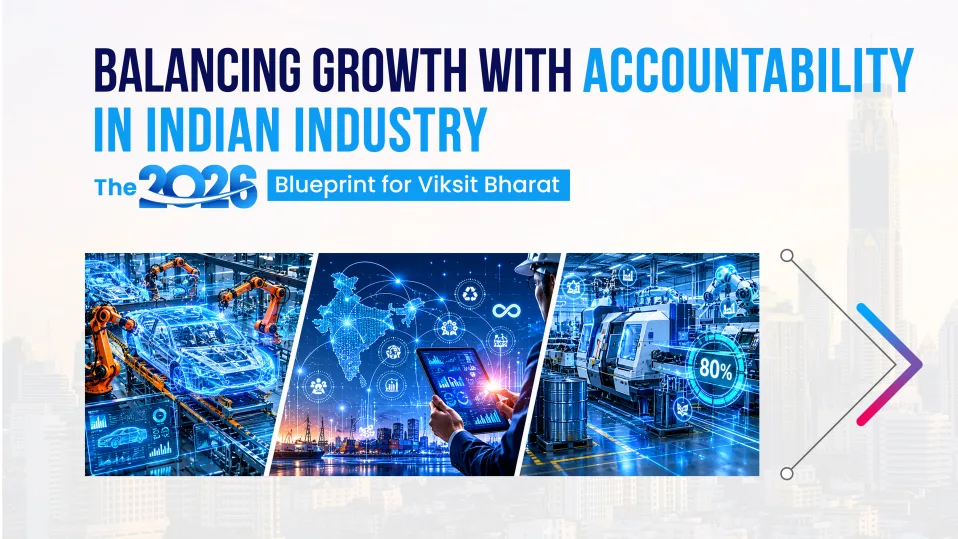
In the high-octane landscape of the 2026 Indian economy, a singular narrative dominates the boardroom and the parliament alike: the equilibrium between rapid industrial expansion and uncompromising institutional accountability. As India solidifies its position as the world’s fastest-growing major economy- with a real GDP growth rate estimated at 7.6% for FY26 (World Bank)- the stakes for corporate governance and environmental stewardship have never been higher.
In India this shift is especially important because industrial growth is tied to national development, employment generation, infrastructure creation, and supply-chain resilience. Growth that does not carry accountability can create long-term costs for companies and for the broader economy.
Defining Growth and Accountability
Growth in industry usually refers to output expansion, revenue growth, market share, capacity addition, export performance, and job creation. Accountability, however, refers to the systems that ensure those gains are lawful, ethical, transparent, and aligned with stakeholder and public interest.
That includes board oversight, compliance discipline, financial transparency, environmental reporting, responsible CSR execution, grievance mechanisms, and anti-corruption safeguards. In practical terms, accountability is what gives growth legitimacy.
A useful way to frame the relationship is this: growth creates momentum, while accountability creates durability. One without the other is incomplete.
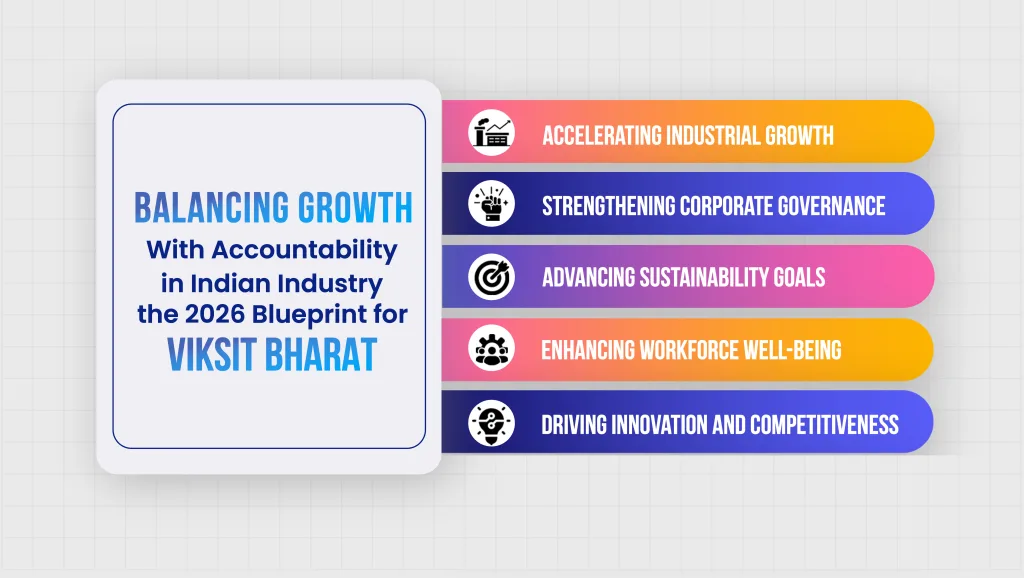
The Growth Imperative: India’s Industrial Velocity in 2026
The Indian industrial sector is no longer just a domestic provider; it is a global linchpin. According to the Press Information Bureau (PIB), the Index of Industrial Production (IIP) registered a robust year-on-year growth of 4.0% as of late 2025, spearheaded by a 4.8% surge in manufacturing.
Key Sectoral Drivers:
- Electronics: India is on track to build a $500 billion electronics ecosystem by 2030. Production value leaped from ₹1.9 lakh crore in 2014-15 to ₹11.3 lakh crore in 2024-25.
- Automotive: India remains the world’s largest market for two and three-wheelers, with the manufacturing of motor vehicles growing at 14.6% annually.
- Steel & Infrastructure: With steel production targets set at 300 million tonnes by 2030, the infrastructure and construction goods sector expanded by 10.5% in the recent fiscal cycle.
The Accountability Framework: From Compliance to Conscience
Growth without accountability is a house of cards. In 2026, “Accountability” in the Indian context has evolved into a three-dimensional framework: Financial Transparency, ESG (Environmental, Social, and Governance) Compliance, and Circularity.
The BRSR Revolution
The Securities and Exchange Board of India (SEBI) has mandated Business Responsibility and Sustainability Reporting (BRSR) for the top 1,000 listed entities. This is no longer a “check-the-box” exercise. Accountability now requires structured data on:
- Carbon Footprint: Mapping emissions across Scope 1, 2, and 3.
- Social Equity: Labor standards, diversity, and community impact.
- Governance: Anti-corruption policies and executive compensation transparency.
Risks of Unchecked Growth
Unchecked growth creates vulnerabilities that do not always show up immediately. These include inflated project claims, poor vendor control, regulatory breaches, environmental non-compliance, and weak social legitimacy.
Such risks matter more in India because large parts of industry operate in ecosystems that include MSMEs, contractors, public institutions, and community stakeholders. If accountability breaks down in one link of the chain, the whole growth story can suffer.
The result is often predictable: growth may continue for a while, but trust erodes, compliance costs rise, and recovery becomes more expensive than prevention.
PHDCCI’s Role: Bridging the Gap
The PHD Chamber of Commerce and Industry (PHDCCI) has emerged as a critical catalyst in ensuring that Indian industry doesn’t just grow, but grows right. Their strategy focuses on three core pillars: Skilling, Circularity, and MSME Formalization.
- The “World of Work” & National Skill Summit 2026
PHDCCI recognizes that accountability starts with a skilled workforce. At the National Skill Summit 2026, held under the theme “Skilled Bharat for Viksit Bharat@2047“, the chamber emphasized that skill development is the bedrock of productivity.
- Impact: Aligning India’s demographic dividend with global standards to ensure that industrial growth is backed by competent, ethical, and “future-ready” professionals.
- Reimagining the Scrap and Recycling Market
In February 2026, PHDCCI hosted a National Conclave focused on the Circular Economy. This is a masterclass in accountability- turning industrial waste into wealth.
- The MetalX Launch: PHDCCI facilitated the launch of MetalX, India’s first institutionally governed digital marketplace for scrap. This platform brings price discovery, traceability, and institutional governance to a sector that was previously 60-70% informal.
- The Sustainability Metric: By promoting scrap usage, industry can achieve an immediate 28% reduction in CO2 emissions per tonne of steel produced.
MSMEs: The Heart of Accountable Growth
Micro, Small, and Medium Enterprises (MSMEs) are the backbone of the Indian industry, contributing 31.1% to the GDP and employing over 32 crore people. However, accountability in this sector has historically been hindered by “informality.”
The 2026 Shift:
The Union Budget 2026-27 introduced the “SME Growth Fund” and TReDS 2.0 (Trade Receivables Discounting System). These initiatives serve two purposes:
- Liquidity (Growth): Providing the capital needed to scale.
- Traceability (Accountability): By moving transactions to digital platforms like TReDS, MSMEs are brought into the formal financial fold, making them “bankable” and accountable to global supply chain standards.
Challenges to the Equilibrium
Despite the optimism, the path to balancing growth and accountability in 2026 faces significant headwinds:
- Global Supply Chain Disruptions: Conflicts in the Middle East have pressured energy prices, potentially moderating growth to 6.6% (World Bank).
- The Cost of Compliance: For many MSMEs, the transition to ESG-compliant manufacturing (low-carbon electricity, alternative fuels) involves high upfront costs.
- Data Integrity: As highlighted by NITI Aayog, building circularity requires a “digital nervous system” for traceability that is still in its nascent stages across many industrial clusters.
Strategic Recommendations for Indian Corporates
To thrive in this new era, Indian businesses must adopt a “Compliance-First” growth strategy:
- Invest in ESG Literacy: Move beyond treating ESG as a legal requirement. It is a value-creation tool that attracts global FDI.
- Adopt Digital Marketplaces: Utilize platforms like MetalX for raw material procurement to ensure ethical sourcing and carbon credit eligibility.
- Prioritize Workforce Skilling: Partner with bodies like PHDCCI to align internal training with the National Apprenticeship Promotion Scheme (NAPS).
Conclusion: The Accountability Dividend
In 2026, the “India Story” is no longer just about the quantum of growth, but the quality of it. Accountability is not a brake on the engine of industry; it is the steering wheel that ensures the engine doesn’t go off track. Through the collaborative efforts of the government (PIB/NITI Aayog), global observers (World Bank), and industry advocates (PHDCCI), India is proving that high-speed growth and high-standard accountability are not just compatible- they are inseparable.