





Pre-Budget Proposals
PHDCCI's pre-budget proposals, with the rationale and the sector data behind each one.
01 Rationalization of Capital Market Taxation (LTCG & STCG) Sector data
Proposal
1. Abolition of Long-Term Capital Gain on sale of equities.
2. Reduction of tax on short term capital gain on sale of Equities from 20% to 10%.
3. Reduction of STT Rates
Rationale
Tax on capital gains is levied on actual profits made. However, STT is a transaction tax levied on the transaction value or the premium value, irrespective of the actual gains made. Further, STT is not a deductible expenditure while calculating capital gains. However, capital losses if any are available as a deduction against capital gains and can also be carried forward. This is a clear case of double taxation which can be mitigated by rationalization of tax rates.
Sector / Industry Growth
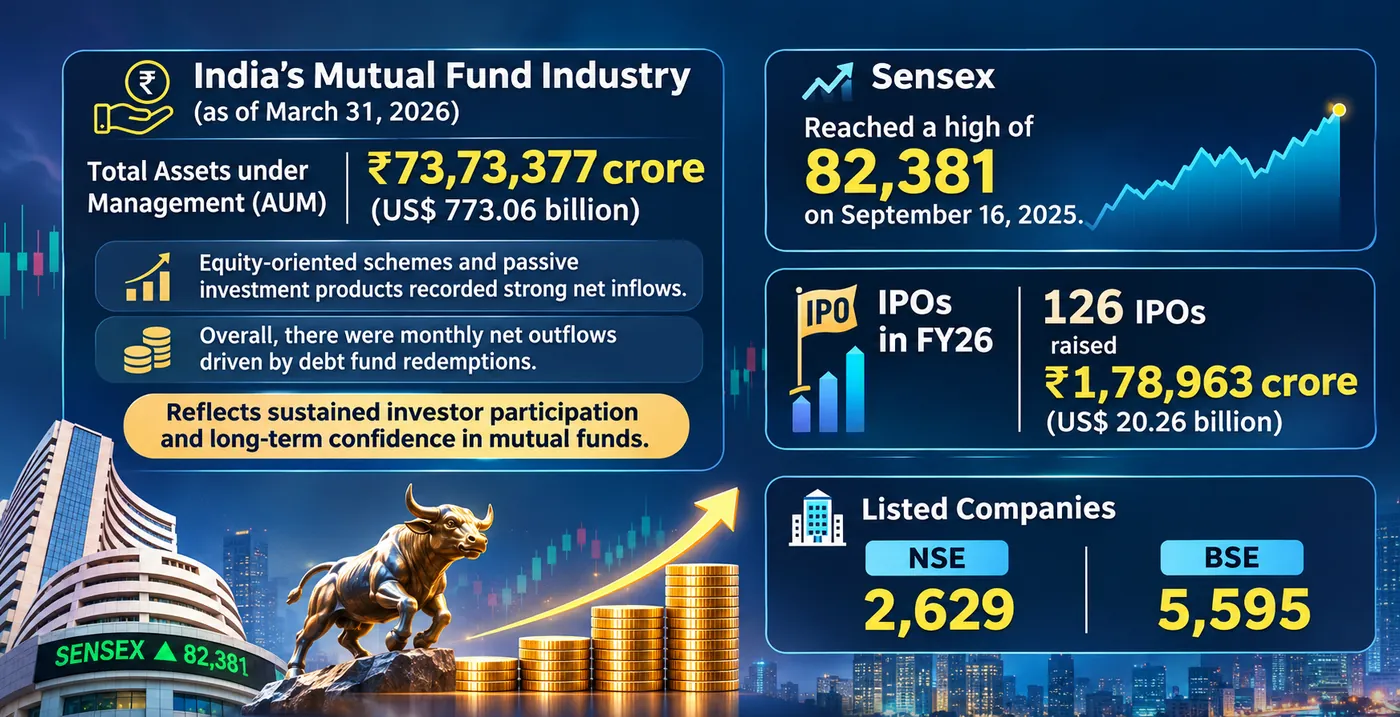
As of March 31, 2026, India’s mutual fund industry’s total assets under management (AUM) stood at a robust Rs. 73,73,377 crore (US$ 773.06 billion), with equity-oriented schemes and passive investment products recording strong net inflows despite overall monthly net outflows driven by debt fund redemptions, reflecting sustained investor participation and long-term confidence in mutual funds.
Indian stock market Sensex reached high of 82,381 on September 16, 2025.
In FY26, a total of 126 IPOs were launched raising Rs. 1,78,963 crore (US$ 20.26 billion).
The number of listed companies on the NSE and BSE were 2,629, and 5,595 respectively.
02 Request for reduction in rates of taxation for Individuals, partnership firms and Limited Liability Partnership concerns Sector data
Proposal
The maximum tax rate for income upto 30 lakhs should be 20% and from 30 lakhs to 50 lakhs should be 25% and beyond 50 lakhs it could be 30%
Rationale
The medium and small business are in many occasions carried out in partnership firms / LLP. The tax rate on partnership firm / LLP still remains highest @ 30% + surcharge when the corporates are taxed at 15% and 25%. Also, majority of MSMEs particularly in the services sector are partnership firms facing high tax rates. These partnership firms cannot function as corporates due to requirements of their governing professional bodies like Chartered Accountants, Lawyers etc.
Sector / Industry Growth
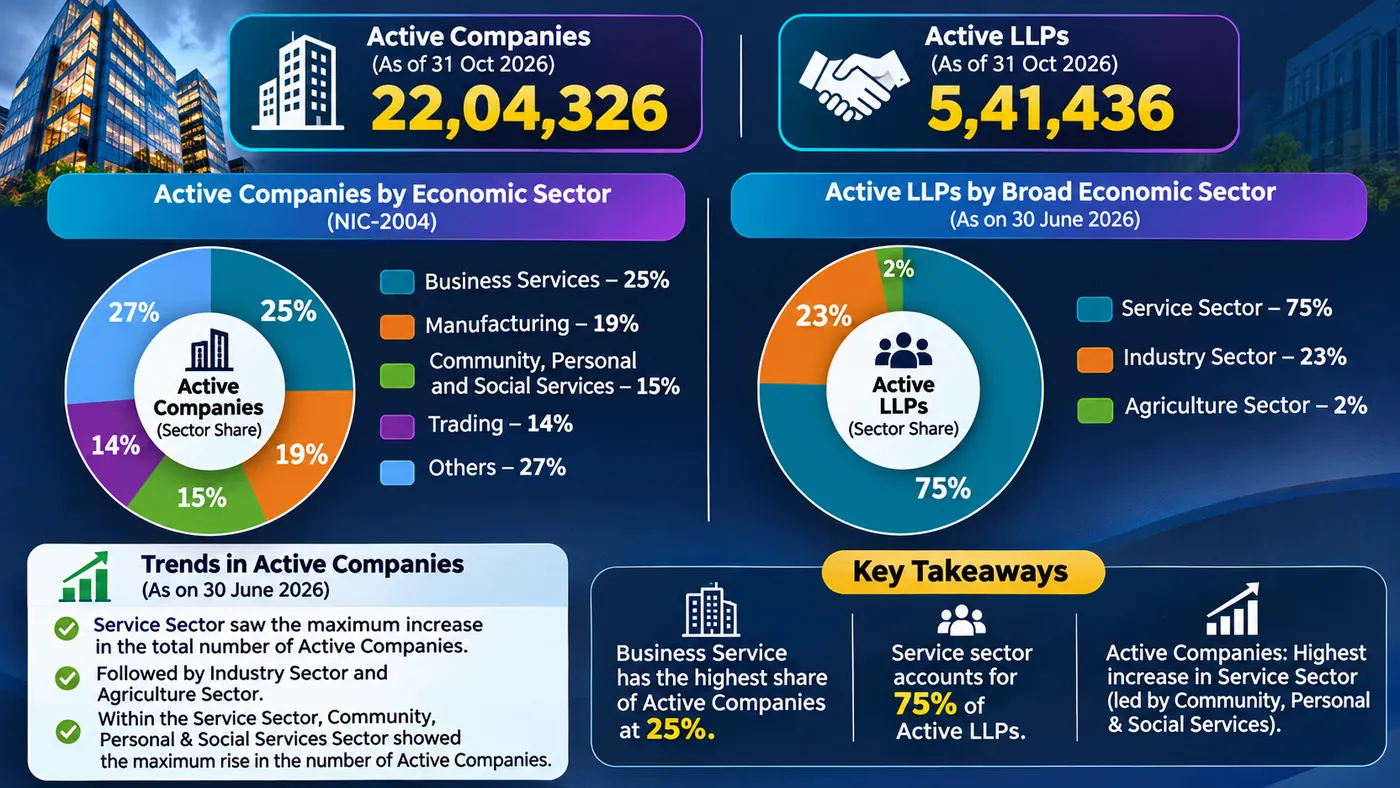
Active Companies (As of 31 Oct 2026): 22,04,326
Active LLPs (As of 31 Oct 2026): 5,41,436
Economic Sector-wise classification (NIC-2004) reveals that the Business Service has highest number of Active companies (25%) followed by Manufacturing (19%), Community, personal and Social Services and Trading (15% and 14%). It is also observed that Service Sector saw the maximum increase in the total number of Active Companies, followed by Industry Sector and Agriculture Sector. In the Service Sector, Community, personal & Social Services Sector showed the maximum rise in the number of Active Companies. (as on 30th June 2026)
Broader economic sector-wise classification of active LLPs as on 30th June, 2026 reveals that the Service sector continues to account for maximum registrations with 75% LLPs, followed by Industry and Agriculture sectors accounting for 23% and 2% respectively.
03 Rationalization of demand recovery Procedural
Proposal
Notification/ circulars issued requiring the assessee to pay only 10% of the core tax demand till the matter is pending before CIT(A)
Rationale
Taxpayers appealing against disputed tax demands face severe liquidity constraints due to high tax deposit requirements.
The current provision requires the assessee to pay 20% of the outstanding demand till the matter is pending before CIT(A).
Although CBDT guidelines require a 20% pre-deposit of disputed tax to secure a stay, Finance Minister Nirmala Sitharaman announced in Budget 2026 that this threshold will be reduced to 10%, calculated strictly on the core principal tax demand (excluding interest).
Despite the budget announcement, the CBDT has yet to issue formal implementation circulars, leaving Assessing Officers to continue enforcing the 20% rate.
Sector / Industry Growth
Procedural recommendation04 Guidelines for Seizure of gold and jewellery found during the course of search Sector data
Proposal
It is necessary that adequate instructions are given or changes are made to the Income Tax Act so that the gross weight of jewellery declared in the last wealth-tax return as increased by the jewellery purchased subsequently, represents the jewellery disclosed by the assessee to the Income Tax Department and jewellery to that extent is not seized during income tax searches.
It is necessary that adequate instructions are given or changes are made to the Income Tax Act so that the gross weight of jewellery declared in the last wealth-tax return as increased by the jewellery purchased subsequently, represents the jewellery disclosed by the assessee to the Income Tax Department and jewellery to that extent is not seized during income tax searches.
Rationale
As per guidelines for seizure of jewellery and ornaments found in the course of search, Instruction No. 1916 dated 11th May, 1994 was issued. As per the aforesaid instruction, the following condition were specified: In the case of assessees not assessed to wealth-tax, gold jewellery and ornaments to the extent of 500 grams per married lady, 250 grams per unmarried lady and 100 grams per male member of the family need not be seized.
The aforesaid instruction was issued in 1994 and more than 32 years have passed since then. It is apparent that times have changed and it is requested that the quantity of jewellery may be enhanced accordingly, keeping in view that the quantity of 500 grams, 250 grams and 100 grams in today's times is extremely less.
As per another condition in the instruction No. 1916 dated 11th May 1994, in the case of wealth-tax assessees, gold jewellery and ornaments found in excess of the gross weight declared in the wealth-tax return only needs to be seized.
However, practically it is seen that the aforesaid instruction is not adhered to and the Investigation Wing specifies that unless each and every specific item of jewellery found during search was disclosed in the last wealth-tax return, then only the same will be considered to be part of jewellery declared in the wealth-tax return.
Sector / Industry Growth
In FY26, cut and polished diamonds accounted for the largest share of gems and jewellery exports at 43.87%, followed by gold jewellery and silver jewellery. India’s Gems & Jewellery market size stood at Rs. 7,31,255 crore (US$ 85 billion) in January 2026 and is projected to expand to Rs. 11,18,390 crore (US$ 130 billion) by 2030. During FY26 (April-March 2026), India's gems and jewellery exports stood at Rs. 244827.26 crores (US$ 27.72 billion). The latest growth momentum is being driven by increasing global demand for gold jewellery and cut & polished diamonds, supported by favourable trade agreements and rising consumer spending in key markets such as the US, UK, and the Middle East, according to IBEF.
ICRA forecasts around 15% value growth for the domestic gold jewellery industry in FY2027, primarily
supported by sustained high gold prices and investment demand, even though gold jewellery volumes are
expected to decline by around 20% year over year (YoY). Demand for gold exchange-traded funds (ETFs) and
investment in gold bars and coins, which accounted for around 41% of India’s volumetric gold consumption in
FY2026, is expected to grow by 4-6% in FY2027, following a 22% rise in FY2026. This is expected to help
cushion the decline in overall gold demand to 9-11% in FY2027. Wedding-related purchases (which constitute
about 60% of gold jewellery consumption) and increasing disposable income in the rural economy are
expected to partially mitigate the overall volume decline amid elevated gold prices.

05 Fast tracking of Faceless Appeals by introducing statutory Period within which appeal order has to be passed in allowing option of physical CIT(A) in exceptional cases Procedural
Proposal
1. A statutory period should be specified within which the CIT(A) has to pass the appeal order. In case the appeal order cannot be passed within the prescribed time then specific approval should be obtained from the Chief Commissioner. This should be strictly followed specially in matters wherein no additional evidence is filed before the CIT(A).
2. The assessee at its option may be allowed to opt for physical CIT(A) specially where there is high pitched assessment or where the addition made is disproportionate to the return of income filed by the assessee. This is in line with regime of the physical CIT(A) in case of search related cases.
Rationale
The faceless assessment was introduced by this Govt. and the tax payer community is reaping benefits in respect of faceless assessment proceedings. The overall experience has been very rewarding, satisfying, tax-friendly and transparent. However, in respect of faceless appeals, the desired results have not come and following shortcomings are there: -
The pendency of appeals is huge and appeals filed in Calander Year 2018 also have not been decided till date.
Only small appeals related to intimation u/s 270(1) or very simple matters have been decided.
The delay in disposal of appeals has resulted in anxiety among the tax payers and also the blockage of funds as 20% demand needs to be deposited before the Income Tax Department.
Sector / Industry Growth
Procedural recommendation06 Taxation of Buy back of Shares Sector data
Proposal
Taxation should be based on the actual gains arising from the buyback after allowing the cost of acquisition, rather than imposing an additional tax burden merely on account of promoter status.
Rationale
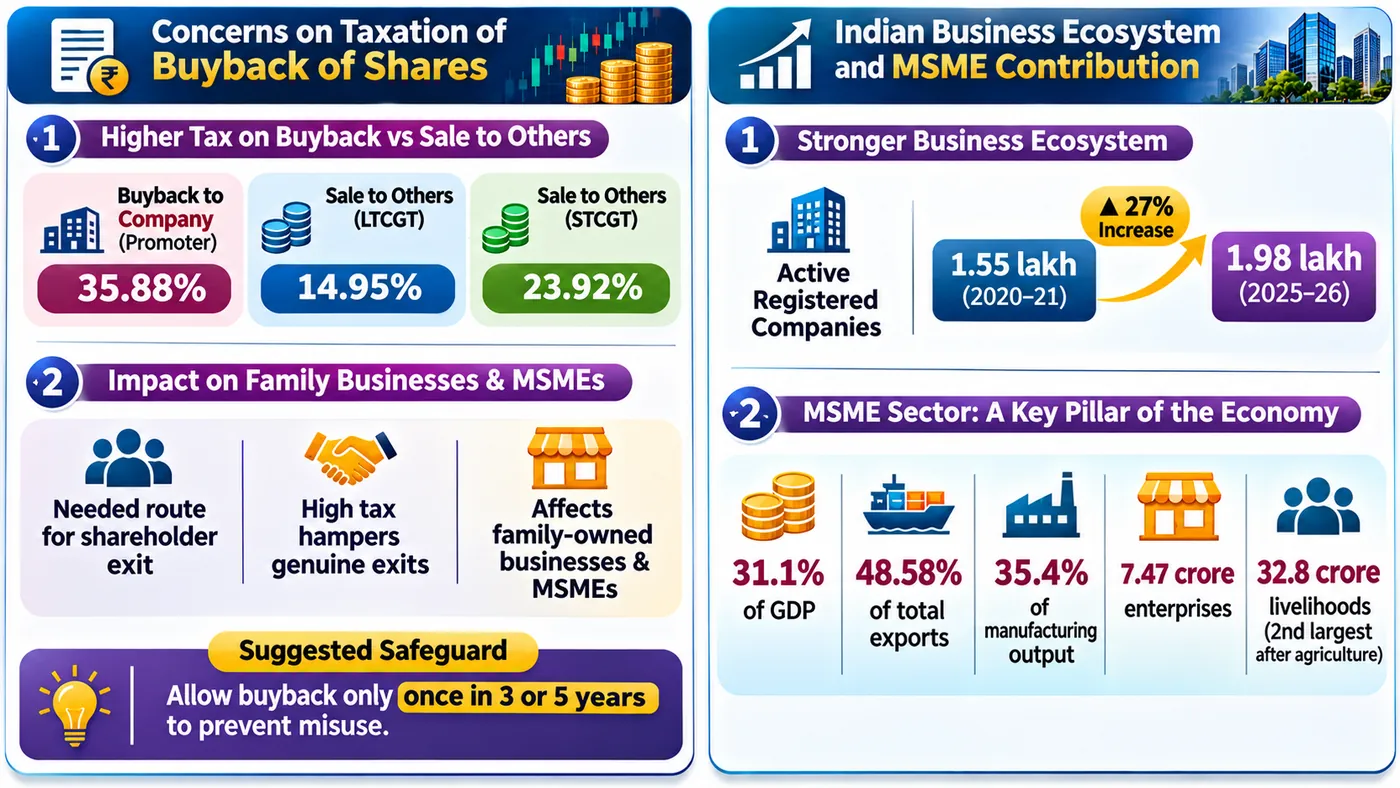
1. If the promoter shareholder sells his shares in buy back to the company, he pays 35.88%, whereas if he sells these shares to any other person/ entity, he would either pay LTCGT of 14.95% (including surcharge & cess) or STCGT of only 23.92% (including surcharge & cess).
2. Adverse Impact on Family-Owned Businesses and MSMEs: In many cases of family-owned businesses, or businesses held by group of families, or friends, or partners, sometimes it becomes necessary to provide exit to a particular group of shareholders. And since the main operating company owns the majority funds through which the exit is to be given to a particular group of shareholder, therefore, in such cases, buyback of shares by the company becomes the only route to give exit to the particular group of shareholder. Taxing the buyback of shares at the rate of 35.88% becomes detrimental and many genuine transactions cannot be executed due to this extremely high rate. In case the government is of the opinion that buyback of shares has been used as a tool for distribution of yearly dividend in the garb of buyback, then necessary provisions can be made to the Companies Act allowing buyback of shares once in 3 years or once in 5 years so that there is no misuse by the companies.
Sector / Industry Growth
1. The Indian business ecosystem has strengthened and the same is witnessed by an approximate 27% increase in the number of active registered companies in just five years. It grew from 1.55 lakh in 2020–21 to 1.98 lakh in 2025–26 (as on 3 February 2026).
2. MSMEs contribute about 31.1% to India’s GDP, account for 48.58% of total exports, and generate around 35.4% of manufacturing output. The sector encompasses more than 7.47 crore enterprises across manufacturing, services, and trade activities. It provides livelihoods to approximately 32.8 crore people, making it the second-largest source of employment after agriculture. (reported on 14 MAY 2026)
07 Re – Introduction of Section 201 (for new manufacturing units) of the Income Tax Act, 2025 (Earlier section 115BAB of the Income Tax Act, 1961) Procedural
Proposal
Reintroduce section 201 of the Income Tax Act, 2025, wherein a concessional rate of corporate tax of 15 percent plus surcharge was introduced for new manufacturing units complying with certain conditions.
Rationale
A concessional rate of tax of 15 percent would provide as a major incentive for foreign companies to set up subsidiaries in India and invest in manufacturing units and this could help in growth of the economy, job creation and could result in India being one of the major manufacturer of goods in the world.
Sector / Industry Growth
Procedural recommendation08 Weighted deduction on research & development expenses Sector data
Proposal
corporates should be encouraged to augment research and development expenditure and weighted deduction at the rate of 150% under section 35 should be reintroduced to continue indefinitely without any sunset clause.
Rationale
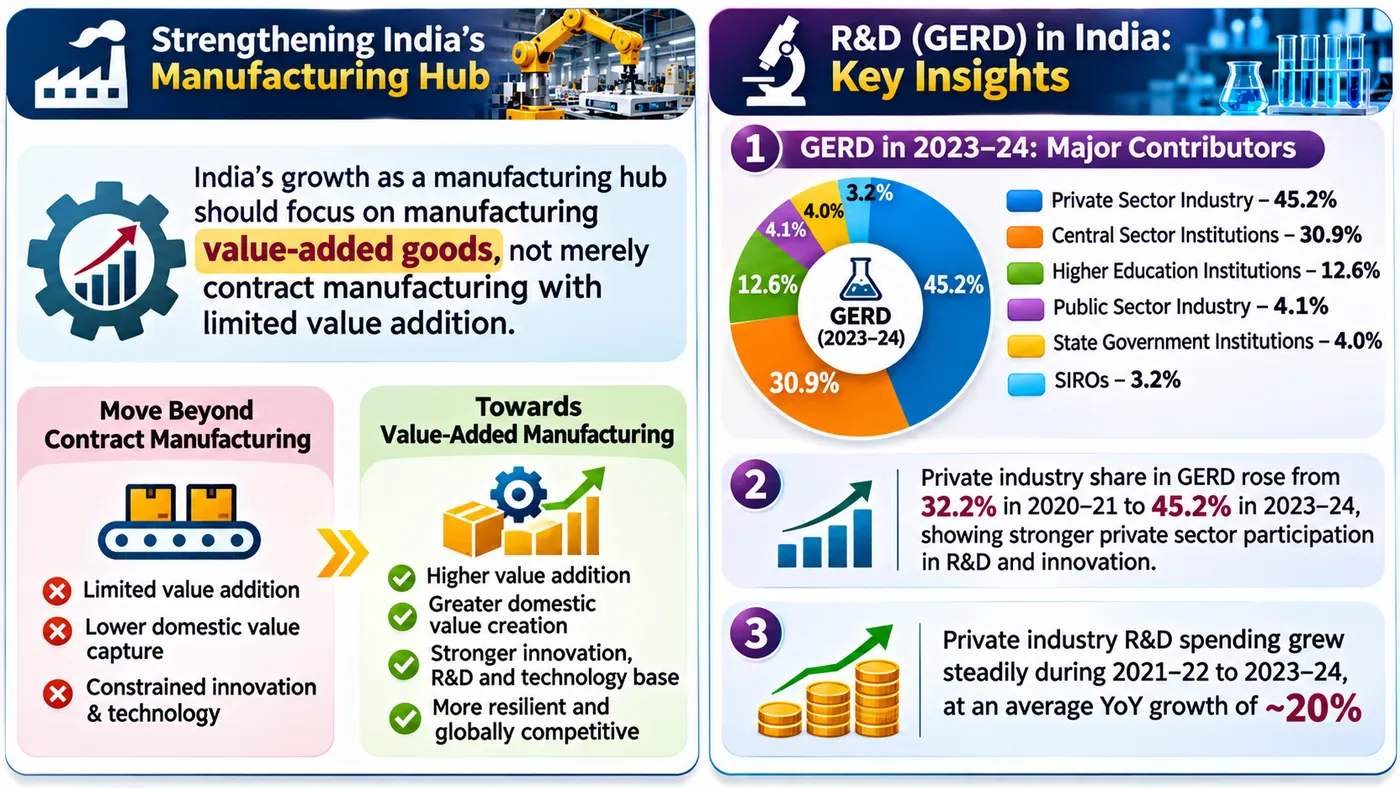
India's growth in the manufacturing as a manufacturing hub should also result should also result in manufacturing of value added goods and not merely doing contract manufacturing with limited value addition.
It is imperative for the Indian corporates to invest in Research and Development, so that India is able to emerge as a hub for innovation and research and not merely production of simple goods.
Weighted deduction for research and development expenses was allowed up to 31st March 2020 by giving weighted deduction of 150% of the expenditure incurred under section 35 of the Old Income tax act, 1961 (Section 45 of the Income Tax Act, 2025).
Sector / Industry Growth
1. During 2023-24, GERD is mainly driven by the Private Sector Industry (45.2%), Central Sector Institutions (30.9%), Higher Education Institutions (12.6%), and Public Sector Industry (4.1%). Institutions under the State Government contribute 4.0%, and SIROs contribute 3.2% in GERD.
2. The share of private industry in GERD increased significantly from 32.2% in 2020-21 to 45.2% in 2023–24, highlighting stronger private industry participation and investment in research, innovation, and technological development in the recent years.
3. The private industry R&D spending grew steadily between 2021-22 to 2023-24, maintaining an average year-on-year growth rate of
approximately 20%.
09 Requirement of personal deposition of the assessee before the Income Tax Department Procedural
Proposal
Certain amendment be made in the Act wherein personal deposition is allowed only in respect of the assessee at whose premises search has been carried out or in respect of any other person wherein escapement of income is apparent and there is substantial evidences to prove that there has been escapement of income. Personal deposition should not be allowed in case of roving inquiries or where there is no concrete proof against the assessee.
The notice for personal deposition shall be issued only with the permission of the commissioner so that the number of personal depositions can be curtailed.
Rationale
During proceedings, it is seen that in many cases on the basis of information received during search at other parties or in respect of information received from foreign countries, the Investigation Wing of the Income Tax Department issues notices to various assessee to verify whether they have correctly reported their income in their income tax returns.
However, during the course of such investigation proceedings, it is seen that the assessing officer in addition to the filing of details also requires personal deposition of the assessee. This causes undue harassment and pressure on the assessee.
Sector / Industry Growth
Procedural recommendation10 Rectification of mistakes and intimation u/s 270(1) by jurisdictional assessing officer, or by special team at CPC Procedural
Proposal
In case where some addition is made in the intimation u/s 270(1) or some TDS credit is not allowed then the file should be transferred to the Jurisdictional Assessing Officer (JAO) on request of assessee, so that the matter can be rectified by him. Otherwise, it takes two years or more for the file to get transferred to JAO.
As an alternative, a special cell can be made in the CPC or in the local income tax offices to address the matters arising out of erroneous intimations u/s 270(1).
Rationale
The Centralised Processing Centre (CPC) has been doing an exceptional job and the refunds are being issued within remarkable time periods. However, in some cases due to some errors in the CPC software, certain additions are made to the returned income or there is shortfall in allowance of TDS credit and such errors are almost impossible to rectify. Some common errors which are noticed are:-
Computation of wrong rate of surcharge on dividend income
Not allowing credit for TDS which was appearing in Form 168 of earlier year and duly carried forward in that year.
Cases where deduction for cost of acquisition / cost of improvement is not allowed properly from the sales consideration while computing the capital gains.
In some cases, the CPC is allowing proportional TDS credit on the grounds that entire income as shown in the TDS certificate is not reflected in the return of income in spite of clarifications filed before the CPC.
The CPC helpline does not provide any fruitful results. The only thing they suggest is to file request for re-processing of the ITR which brings no benefit.
Sector / Industry Growth
Procedural recommendation11 Simplification in Tax Rates Procedural
Proposal
for every category of tax payer there shall be only one tax rate which shall include the tax and the cess and the surcharge to ensure easy understanding.
Rationale
To promote simplification of tax laws and understanding of tax rates, it is recommended that the tax rates be made simpler. As of now for every tax rate, there is main tax, there is surcharge and there is cess.
It is known that surcharge and cess are shared by the Government with the State Government. However, this remains an internal issue of the Government which can be taken care of by an accounting entry.
Sector / Industry Growth
Procedural recommendation12 Exemption u/s 82 / u/s 86 where house property purchased in the name of wife / family member Procedural
Proposal
suitable amendment be made in the Income Tax Act where it is prescribed that benefit of Section 82 / 86 shall be allowed even if new property is purchased in the name of assessee’s wife / daughter etc.
Rationale
To promote housing, the Government has prescribed Section 82 and Section 86 providing exemption from Long Term Capital Gain where the amount of capital gain is invested in a residential house. The State Governments have promoted registration of properties in the name of women to provide them security and social importance and have prescribed a lower rate of stamp duty for the women.
Many Courts have held that in case the capital gain is earned by an assessee and the house property is purchased in the name of his immediate family member, then also benefit of exemption u/s 82 / 86 shall be available.
However, there is no specific provision in the Income Tax Act to allow this situation.
Sector / Industry Growth
Procedural recommendation13 Time limit for providing No Objection Certificate by the Income Tax Department to the National Company Law Tribunal for allowing the merger / demerger matters Procedural
Proposal
a statutory period of 60 days may be specified in the Income Tax Act within which the application for NOC during merger process is either sanctioned or rejected.
Rationale
The process of merger / demerger normally takes a period of 6 – 12 months. During merger process, the NCLT insists upon No Objection Certificate from the Income Tax Department. In many cases, such NOC takes undue time at the level of the Income Tax Department resulting in delay in merger process by 3 – 6 months.
Sector / Industry Growth
Procedural recommendation14 Time Limit for issue of remand report by A.O. during appeals Procedural
Proposal
It is requested that a time period of 60 days may be specified in the Income Tax Act for furnishing of remand report which may be extended by the CIT in exceptional circumstances.
Rationale
The procedure of deciding appeals whether faceless or physical is mainly delayed due to non-submission of remand report by AO on time. As of now, there is no time limit for furnishing a remand report by the AO.
Sector / Industry Growth
Procedural recommendation15 TDS / TCS certificate requirement Procedural
Proposal
The need for issue of TDS certificates exists only in following three cases viz.
Salary TDS certificates in Form 130 – This is an important document for salaried employees (including pensioners) which is used for many commercial transactions like borrowing loan, buying insurance policies, etc.
Non-residents – Issue of TDS certificate is essential to enable them to claim FTC in their home country.
Section 397(2)(b)(i)/ section 397(2)(b)(ii) cases where PAN is not available and higher TDS/TCS applies - since the TDS/TCS cannot be populated in Form 168 in such cases.
Hence, to reduce compliance burden, it is recommended that the requirement to issue TDS / TCS certificate can be done away with exceptions for (A) Salary TDS certificates in Form 130,
(B) TDS certificates to non-residents and (C) Higher TDS/TCS where PAN is not available.
Rationale
Section 395(4) read with Rule 215 requires all tax deductors to issue TDS certificates to the deductees. Similarly, section 395(4)(a) read with Rule 215(1) (Table S. No. 4) requires all tax collectors to issue TCS certificates to the collectees. There is penalty prescribed of Rs. 100 per day for default in furnishing of such TDS/TCS certificates under section 465.
However, practically, such TDS/TCS certificates have no relevance since TDS/TCS credit is granted on the basis of information appearing in AIS/Form 168 and the TDS/TCS certificates are neither required to be furnished along with return nor required to be furnished in assessment proceedings.
It merely adds to compliance burden of tax deductors/collectors.
Sector / Industry Growth
Procedural recommendation16 Section 206(3) & 206(4) of the Act – Carry forward of minimum alternate tax (MAT) credit in the case of demerger/amalgamation Procedural
Proposal
It is suggested that MAT credit should be allowed to be transferred to resulting company in case of demerger / amalgamation.
As per ICAI Guidance Note on Accounting for Credit on MAT, MAT credit is treated as an asset. The Act stipulates conditions for “demerger” inter alia that all the property of demerged company should become property of resulting company. Similar condition is also provided in case of amalgamation. Therefore, the MAT credit should also be allowed to be transferred to the resulting company.
Rationale
Although, the MAT credit can be carried forward for 15 years, however, in case of demerger/amalgamation, there is no clarity whether MAT credit can be transferred to resulting company. There are contrary rulings in this regard. However, in the absence of any guidance by CBDT or High Court / Apex Court, there is need for clarity on this issue.
Sector / Industry Growth
Procedural recommendation17 Option to claim credit for TDS certificate which were not appearing in Form 168 at the time of filing of the Income Tax Return due to late filing of TDS return by the deductor Procedural
Proposal
an amendment may be made in the Income Tax Act allowing revision of income tax return beyond the period currently allowed only for claiming the unclaimed TDS credit. In the alternative some other mechanism may be introduced to allow credit for such TDS.
Rationale
In many cases it is seen that due to financial hardships the deductors of TDS are depositing TDS late after delay of 2-3 years.
Recently in the case of Spicejet, TDS arrears of around 350 Crores were deposited after a delay of 2 – 3 years. In such cases, the TDS credit is reflecting in the Form 26AS after the due date of filing / revising the Income Tax Return by the deductee has already passed.
In these cases, the amount of TDS credit is a financial loss as the credit is not available to the assessee.
Sector / Industry Growth
Procedural recommendation18 Specific provision to be inserted in section 11 to clarify that compensation received under the right to fare compensation and transparent in land acquisition, Rehabilitation and Resettlement Act 2013 be exempt from tax Procedural
Proposal
1. Specific provision may be inserted in Section 11 to clarify that compensation under section 96 of RFCTLAR shall not be taxable;
2. On parity, aforesaid exemption must also be extended to a landowner selling TDR.
Rationale
In terms of section 96 in The Right To Fair Compensation And Transparency In Land Acquisition, Rehabilitation and Resettlement Act, 2013 (RFCTLAR), no income tax is payable on any award received pursuant to company acquisition of land. This aspect has been clarified by CBDT vide circular no.36/2016 dated 25th October 2016, though there is no corresponding amendment in the IT Act.
Further, certain State Governments have, however, to facilitate/ expedite the process of compulsory acquisition and arranging alternate mode of compensation, come out with scheme of issues of TDR certificate in return of acquisition of land. As per this policy, in lieu of vesting of land required by the State Government, TDR Certificate, which can be monetised by the landowner by selling it to various developers/users in the same Development Plan [Refer Memo No: Misc-454 /2021/28849 dated: 16.11.2021 issued by Government of Haryana].
This scheme serves twin benefits, viz., (a) fast-track vesting of land in government; and (b) instead of government paying compensation, landowner receive compensation by selling the TDR.
Insofar as the landowner is concerned, this is only alternate way of receiving compensation for compulsory acquisition of law. Therefore, on parity, compensation received by monetising TDR must also be given treatment similar to the landowner covered by section 96 of RFCTLAR.
Sector / Industry Growth
Procedural recommendation19 Variations of 10% allowed under section 78 and section 92(2)(m) increased to 20% for secondary sales also, and without limit of any amount Procedural
Proposal
1. The variation of 20% allowed is only in respect of transactions carried on upto 30.06.2021 which needs to be extended to give boost to the real estate sector.
2. It said variation of 20% has been introduced only for primary sale of residential units of value upto Rs. 2 crores.
3. The step taken by the Ministry of Finance is a welcome step but considering the current situation of economy and the real estate sector, it is suggested that the said benefit of variation of 20% between circle rate value and actual sale consideration be extended upto 31.03.2023to the following:
Secondary sale or Re-sale of residential units;
Limit of Rs. 2 crores maybe remove.
Rationale
As per provision of section 53, 79 and 92(2)(m), in case of sale of immovable property, difference between agreement value and stamp duty value, in excess of 10%, is taxable in the hands of seller as well as purchaser, which amounts to double taxation. Due to downturn in market and Covid impact, the market prices of the properties in most cases have gone down substantially and due to economic consideration (premiums on development of properties constitute major source of income of the local bodies and/or state governments) the state government and/or local bodies are averse to reduce the ASR.
Due to pandemic situation, this 10% difference seemed quite low and there are differences of much greater amount due to various factors such as distress sale etc.
The Ministry of Finance in the recently introduced Atmanirbhar Bharat Package 3.0 has announced that 20% variation shall be allowed under Section 78 and Section 92(2)(m) for only primary sale of residential units of value up to Rs. 2 crores upto 30.6.2021
Sector / Industry Growth
Procedural recommendation20 Limit of presumptive tax scheme for professional under Section Section 58(2) – Sr. No. 3 to be increased to Rs. 1 crore Procedural
Proposal
1. The limit prescribed of gross receipts of Rs. 75 Lakhs should be increased to Rs. 1 Crore in order to include more professionals under the scheme.
2. The deemed profits of 50% of the gross receipts can be reduced to 33.33% (One-third) of the gross receipts in the previous year as was also recommended by the R.V. Easwar Committee Report. The benefit of the provision be also extended to LLP.
Rationale
An optional scheme of presumptive taxation in case of specified professionals is provided under the provision of Section Section 58(2) – Sr. No. 3 wherein the income from profession is computed and offered to tax on a presumptive basis at a rate of 50% of the gross receipts. Only individuals or partnership firms whose gross receipts from profession does not exceed Rs. 75 Lakhs in a financial year can opt to be taxed under the presumptive scheme.
Sector / Industry Growth
Procedural recommendation21 Removal of income computation and disclosure standards Procedural
Proposal
Due to the reasons stated above, it is suggested that ICDS be completely withdrawn and financial Accounts prepared as per IND-AS (Generally Accepted Accounting Standard) or in compliance with Companies Act (IGAP) should be accepted for computation of income for tax purpose, subject to specific adjustments like tax depreciation and 28 to 57 and Sections 59 to 65 of the Act as provided in Income Tax Act, 2025.
Rationale
1. ICDS in its present form is not adding any value and in fact, is bound to create uncertainty and deterrence in the conduct of business in India. It militates against the professed policy of the Government to promote ease of doing business and to simplify the taxation system which will consequently impact the “Make in India” objective as this will create major obstacles to doing business in India. While amendments in the law, guidelines and standards are made with the intent of reducing litigations, it is feared that notification of these ICDS have not achieved this objective.
2. It is apparent that with a huge divergence in the accounting prescribed under IndAS regime, overwriting of the law established through judicial precedents, coinage of new terminologies, there would be an increase in unintended tax litigations.
Sector / Industry Growth
Procedural recommendation22 Deduction against dividend income not to be capped at 20% of interest paid Procedural
Proposal
It is suggested that the actual amount of interest paid shall be allowed as a deduction subject to maximum of dividend income.
Rationale
Section 93 mentions that no deduction shall be allowed against dividend income or against income from units. Also, it has been mentioned that where interest has been paid for acquiring the shares / units then the deduction for such interest shall not exceed 20% of dividend income or income from units. The capping of 20% of dividend income is not warranted.
Sector / Industry Growth
Procedural recommendation23 Losses to be allowed in case of merger of all companies as against right now allowed only for Manufacturing company Procedural
Proposal
Allow the losses in-case of mergers all of the other entities not only the manufacturing entities
Rationale
1. Section 116 of the Income Tax Act, 2025, provides for provision relating to carry forward and set off of accumulated loss and depreciation allowance in case of amalgamation, merger, demerger etc of an industrial undertaking.
2. For the purpose of Section 116, industrial undertaking means any undertaking
3. Which is engaged in the :-
the manufacture or processing of goods, or
the manufacture of computer software, or
any other manufacturing concern.
4. In the current fast growing business world, where all the major business concerns are undergoing mergers, demergers, amalgamation for the purpose of expansion of business, by polling their resources or diversifying consumer base. But, the non-allowance of carry forward of losses in case of merger of non-manufacturing concerns acts as a major setback for all the non-manufacturing entities and hence they lose a opportunity to expand their business
Sector / Industry Growth
Procedural recommendation24 Virtual Digital Asset Sector data
Proposal
• Insert in Section 393 of the Income-tax Act, 2025: Note 7, after Table Sl. No. 8(vi): the obligation to deduct tax at source and comply with the provisions of this serial number extend to all persons resident or non-resident, whether or not, the non-resident person has —
(i) a residence or place of business or business connection in India; or
(ii) any other presence in any manner whatsoever in India.
• Another Circular may be issued by the Central Board of Direct Taxes (CBDT) under the provisions of Section 194S. Therein, the definition of “Exchange” as provided in the CBDT Circular may be amended to
specifically cover foreign Exchanges in language similar to Explanation 2 to Section 195(1) of the Income-tax Act.
• Reduce the rate of tax deduction at source specified in Section 393(1) [Table Sl. No. 8(vi)] from 1% to 0.01%, or another similarly low rate
• A corresponding amendment may be made to the rate referenced in Section 393(4) [Table Sl. No. 12].
• Rationalise the 30% under Section 194 (Table Sl. No. 4) and align it with comparable asset classes.
• The Government may consider a holding-period-based framework, with differentiated rates for short-term and long-term holdings.
• Amend Section 194 (Table Sl. No. 4(b)) [and correspondingly Section 115BBH(2)(b) of the Income-tax Act, 1961] to permit set-off and carry-forward of losses from the transfer of virtual digital assets, subject to a time limitation consistent with comparable trading and investment sectors.
• Amend Section 393(1) of the Income-tax Act, 2025, to explicitly apply TDS obligations to all offshore platforms targeting or servicing Indian residents, irrespective of physical presence or permanent establishment in India.
• Insert a deeming provision (similar to Section 194-O for e-commerce) clarifying that intermediaries facilitating peer-to-peer (P2P) orders are responsible for deducting TDS, eliminating the structural loophole used by non-compliant offshore platforms.
• Issue clarification note to Circular 13 & 14 of 2022 on peer to peer VDA transactions creating interpretation issue on offshore exchanges obligation to deduct applicable TDS on each VDA transactions.
• Rationalize the TDS rate from 1% to 0.01%.
• Amend Section 194(1) of the Income Tax Act, 2025 (formerly Section 115BBH) to permit loss set-offs and carry-forwards for investors transacting through Financial Intelligence Unit (FIU)-registered Financial Intelligence Unit intermediaries, aligning VDAs with standard capital market asset classes.
• Reconsider the flat 30% capital gains rate to establish parity with other investment assets, incorporating lower rates for long-term holdings to foster long-term capital formation in India.
• Introduce Section 379A in the Companies Act, 2013 (via the Corporate Laws Amendment Bill, 2026) requiring foreign entities having significant business presence / interests facilitating Indian users to mandatorily incorporate a local subsidiary or register locally, mirroring regulatory models in Dubai (VARA), the EU (MiCA), and Australia.
• Raise the TDS deduction threshold from INR 10,000 / 50,000 to INR 5,00,000 (par with e-commerce provisions).
• Exempt operational accounts of FIU-registered Virtual Asset Service Providers (VASPs) from TDS deductions.
• Strengthen FIU-IND compliance by directing banking channels and payment gateways to restrict INR flows to non-FIU registered foreign entities.
Rationale
• While Central Board of Direct Taxes (CBDT) Circular No. 13 of 2022 permits buyers/brokers to enter into an agreement with an exchange for the latter to undertake TDS compliance, it does not clarify that this obligation is applicable also on offshore exchanges. As a result, in the case of offshore exchanges, TDS is not being deducted at the exchange level, and the compliance burden is instead shifting to individual resident users, creating significant enforcement and compliance challenges.
• Results in revenue leakage, as TDS is not being deducted at the exchange level for transactions conducted via offshore exchanges, making tax collection and compliance more difficult.
• Bringing offshore exchanges within the TDS framework would centralise collection at an identifiable point and improve tax tracking and revenue assurance.
• It would also create a level playing field between compliant domestic exchanges, which are subject to Indian TDS withholding, and offshore exchanges serving Indian users.
• A materially lower rate would preserve the tracking and tracing function while removing the capital drag that drives users to non-compliant channels.
• A rate of 0.01% is comparable to the transaction-level levies applicable to securities and commodities, and would align VDA treatment with these established frameworks while retaining transaction reporting.
• Higher net tax collection notwithstanding the lower rate, on account of the shift of volume back to compliant platforms.
• Reduced incentive to migrate to offshore and unregulated exchanges.
• Alignment with the transaction-level levies applicable to securities and commodities.
• Aligning the rate with comparable asset classes, and permitting loss set-off subject to a time limitation as applicable to other trading and investment sectors, would restore parity and reduce the incentive to route transactions through non-compliant channels.
• Set-off and carry-forward would align the levy with net income actually earned, removing the anomaly under which tax is payable on gross gains while corresponding losses are disregarded.
• A holding-period-based structure would distinguish long-term investment from short-term speculative activity, consistent with the treatment of listed securities, and would improve taxpayer certainty.
• Parity with other asset classes would reduce classification and treatment disputes and consequent litigation.
• Higher aggregate collection is achievable notwithstanding the lower rate, on account of the return of activity to reporting platforms.
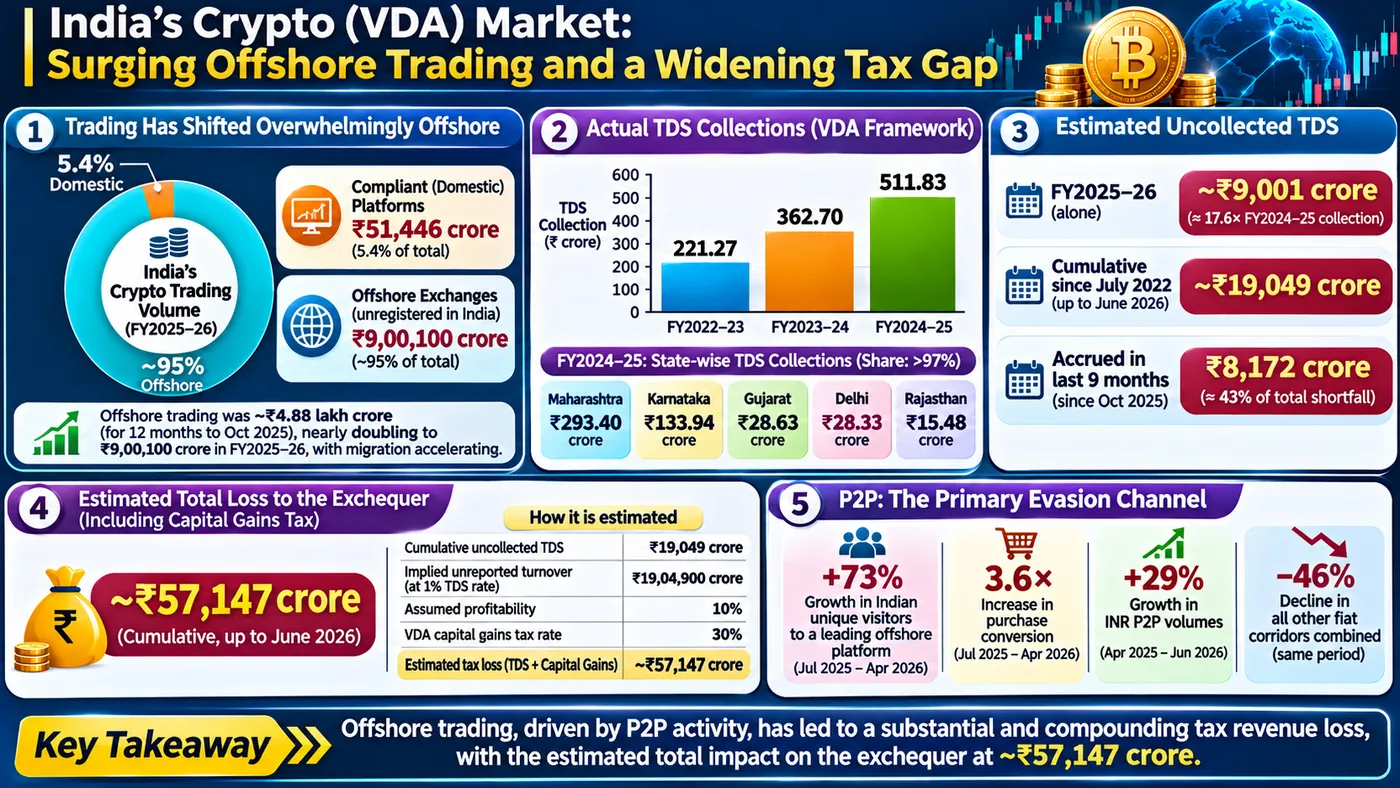
• This displacement is primarily driven by the 1% Tax Deducted at Source (TDS) under Section 393(1) (formerly Section 194S) and the inability to set off or carry forward trading losses. Rather than curbing speculative activity, these provisions have incentivized offshore capital flight, resulting in an estimated cumulative uncollected TDS shortfall of ~₹19,049 crore since 2022 and substantial direct tax losses to the exchequer.
• Rationalisation of TDS maintains the transaction-tracking objective of the tax authorities while removing the friction driving high-frequency retail and institutional traders offshore.
• Repatriating volume to domestic platforms will significantly increase total collected tax revenue.
Sector / Industry Growth
Compliant platforms handled an estimated Rs. 51,446 crore in FY 2025–26, while off shore exchanges, who do not have a registered entity in India thus, - beyond the reach of Indian tax authorities - accounted for the remaining ~95% (Rs. 9,00,100 crore) of India’s crypto volume. The 2025 edition estimated off shore trading of Rs. 4.88 lakh crore for the twelve months to October 2025; the latest fi gure represents a near-doubling within a single period, and the migration has accelerated rather than plateaued.
total TDS collected under the VDA framework stood at Rs. 221.27 crore in FY 2022–23, Rs. 362.70 crore in FY 2023–24, and Rs. 511.83 crore in FY 2024–25 - a cumulative Rs. 1,095.80 crore across three fi nancial years
25 Agriculture Sector data
Proposal
• Clarify that a platform is outside section 393(1), Sl. No. 8(v) where it merely provides communication, information, price discovery, advisory or matching services and the transaction and settlement occur outside the platform.
• Alternatively, exempt transactions involving farmers, FPOs, agricultural cooperatives, agricultural inputs and produce; provide that no withholding arises on direct buyer-to-seller payment outside the operator’s control;
• Reduce the higher rate under section 397 from 5% to 1% for eligible farmer / FPO transactions.
Rationale
• Direct buyer-to-seller settlement leaves the platform with no funds from which tax can be withheld. Requiring deposit from the operator’s own funds creates unrecoverable cost and compliance exposure.
• Withholding blocks farmers’ and FPOs’ liquidity and may require refund claims, while discouraging digital market adoption.
• The expected revenue impact of relief is limited because the proposal concerns withholding and does not alter ultimate taxability.
Sector / Industry Growth
The agriculture and allied industries sector in India has achieved GVA of US$ 592.77 billion in FY26 and accounts for 17.80 percent of GDP of India at constant prices (FY26). Production of foodgrains is estimated at an all-time high of 3,765.63 LMT during FY26, and agriculture exports have reached US$ 53.70 billion in FY26.
The agriculture sector, along with related industries, contributes 17.80% to the GDP (constant prices) of 2025-26, while GVA was recorded at US$ 588.13 billion for FY25 and US$ 592.77 billion for FY26.
The exports from agriculture sector witnessed an increase of 7.17% to Rs. 4,74,697.17 crore (US$ 53.70 billion) during FY26 from Rs. 4,42,918.31 crore (US$ 52.31 billion) during FY25.
Foodgrain production is estimated to be a record 3,765.63 LMT during 2025-26 (Third Advance Estimates) and represents a 5.26% increase from 3,577.32 LMT during 2024-25.
It is expected to continue growing at 4% for the next 10 years and be valued at around US$ 1-4 trillion by 2035.

26 Real Estate Sector data
Proposal
• Restrict the applicability of section 78 only to transactions between related parties.
• Provide for an exception that where assessees can establish with documentary evidence of the price negotiated and agreed between the unrelated buyer & seller -whether higher or lower than the circle value, then such negotiated & documented value shall be considered for computing capital gains under the Act.
Rationale
• Though there is a provision to request Assessing Officer (AO) for a valuation by a Department Valuation Officer, even they refer to circle values published by State Governments leading to unwanted demand on assessees.
• This also needs to avoidable litigation before Appellate forums where assessees end up disputing the demand for higher tax which gets resolved after several years.
Sector / Industry Growth
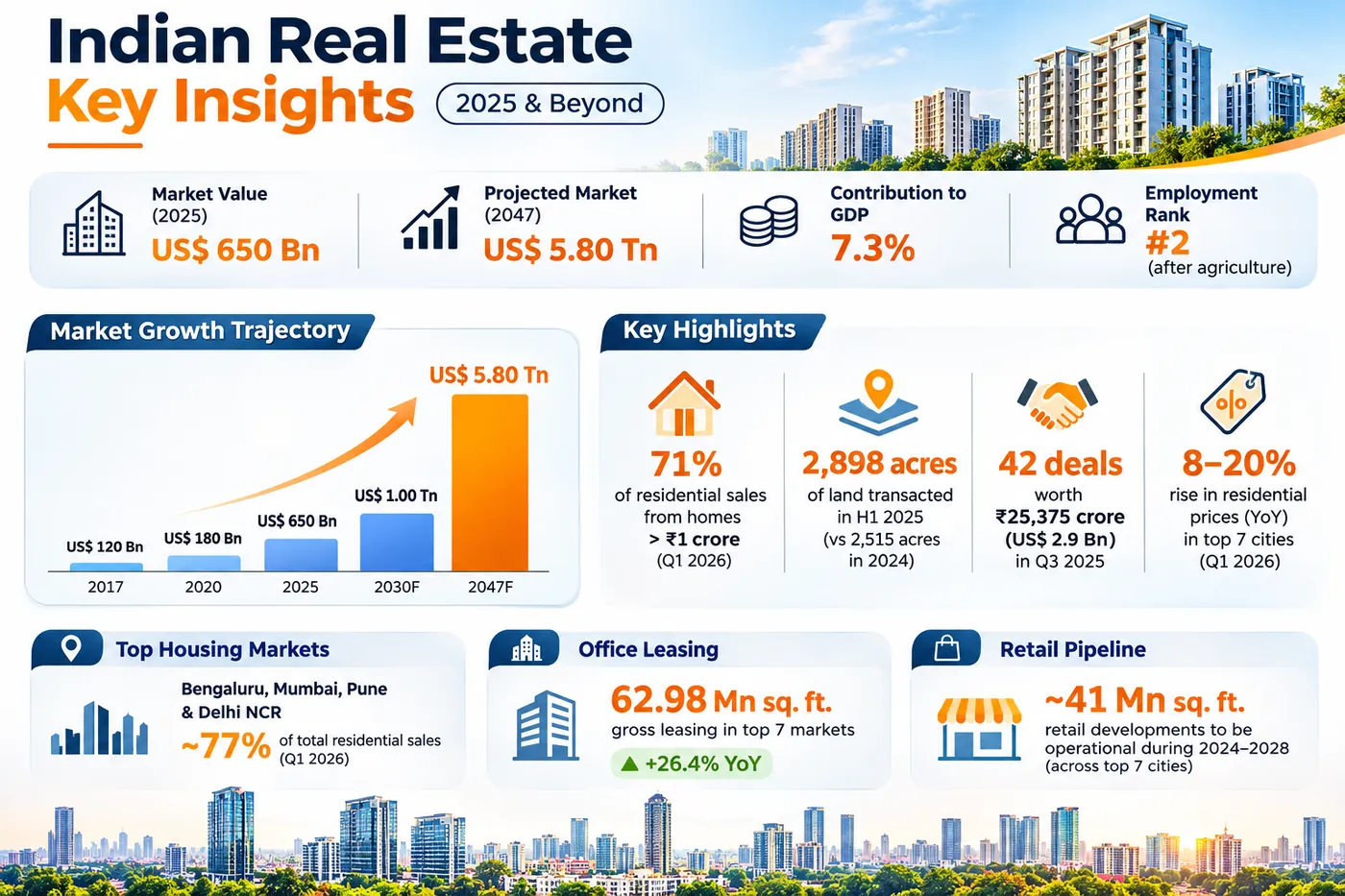
India's real estate market is projected to expand from Rs. 54.96 lakh crore (US$ 650 billion) in 2025 to Rs. 553.38 lakh crore (US$ 5.80 trillion) by 2047, reinforcing its role as a key driver of economic growth and urban development. India's real estate sector contributed 7.3% to the country's Gross Domestic Product (GDP) and remained the second-largest employment generator, highlighting its significant contribution to economic growth and job creation.
Residential property prices across India's seven major cities increased 8–20% year-on-year in Q1 2026, led by Bengaluru, Chennai, Delhi NCR and Kolkata, supported by premium project launches and rising construction costs. Bengaluru, Mumbai, Pune and Delhi NCR accounted for approximately 77% of total residential sales in Q1 2026, reinforcing their position as India's leading housing markets.
India's physical retail landscape is poised for a substantial boost, with nearly 41 million sq. ft of retail developments set to be operational between 2024 and 2028 across the top 7 cities, encompassing projects in various stages from construction to planning.
For the first time, gross leasing in India's top 7 markets surpassed the 60 million sq ft mark, reaching an impressive total of 62.98 million sq ft, marking a substantial 26.4% increase compared to the previous year. Notably, the December quarter emerged as the busiest quarter on record, with gross leasing hitting 20.94 million sq ft. Bengaluru, Mumbai and Delhi NCR remained the leading office markets in Q1 2026, together accounting for over 60% of total gross leasing activity, supported by strong demand from multinational corporations and GCCs.
India's real estate sector attracted Rs. 1.06 lakh crore (US$ 1.20 billion) in institutional investments during Q1 2026, with domestic investors accounting for 57% of total inflows, reflecting strong confidence in the sector despite global economic uncertainties.